The situation
Effective January 1, 2019, the minimum salary for foreign workers in Croatia has increased as follows:
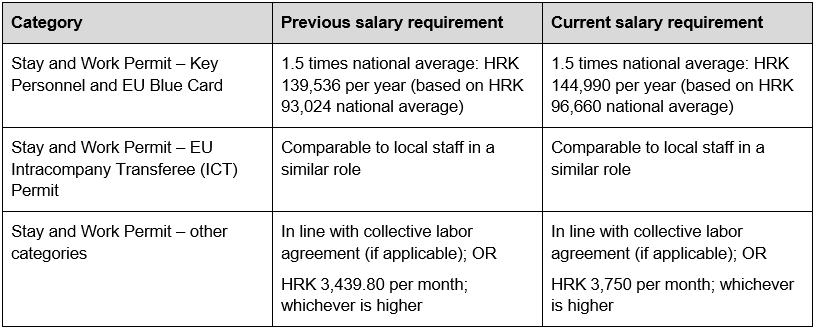
Although there is no formal salary requirement for the short-term Confirmation on Work category, it may be advisable to guarantee the local minimum wage (now HRK 3,750 per month) depending on the circumstances of the case.
A closer look
- Existing employees. Employers of foreign nationals must increase the foreign national’s salary to comply with the new rule.
- Initial and renewal applications. Employers of foreign nationals seeking to obtain or renew work authorization on or after January 1, 2019 must increase the foreign national’s salary to comply with the new rule. Immigration applications that do not meet the minimum salary will be refused.
- Pending applications. Employers of foreign nationals with pending work authorization applications as of January 1, 2019 must increase the foreign national’s salary to comply with the new rule. Immigration applications that do not meet the minimum salary will be refused.
Reminders on other requirements
- Benefits and allowances. As before, benefits and allowances cannot be included in the minimum salary calculation.
- Local salary rate. As before, employers are required under labor law to pay equal salaries for equal work to both foreign and local staff. Consequently, salaries for foreign workers must meet the average local salary rate for the proposed position.
- Currency. As before, employers are required to guarantee the salary in HRK regardless of payroll location and/or exchange rate fluctuations.
Background
In 2017 and 2018, the minimum salary amount went up by five percent.
The minimum annual salary for Key Personnel and EU Blue Card applicants is based on the average gross salary paid in Croatia the previous year, therefore, the increase for these categories occurred when the data from 2017 was made available by the Statistics Bureau in March of 2018.
Looking ahead
The above thresholds are based on average salaries over 2017. The average salaries over 2018 are expected to be published in a few months’ time. Salary requirements for foreign workers will be increased correspondingly in due time once again.
Most European countries have published their new salary thresholds over the past weeks. Countries that have not yet published threshold changes at this time are not expected to implement any changes shortly.
This alert is for informational purposes only. If you have any questions, please contact the global immigration professional with whom you work at Fragomen or send an email to [email protected].

Explore more at Fragomen
Blog post
Senior Associate Arta Djahanschiri and Associate Iris Barthel discuss how EU-Turkey Association Law, including Association Council Decision No. 1/80, can provide Turkish employees and their family members in Germany with residence and labor market rights that may extend beyond protections available under the German Residence Act.

Media mentions
Partner Marius Tollenaere and Associate Jamela Sharrock examine how employers in Germany can strengthen immigration compliance by embedding it into every stage of the employment lifecycle.
Podcast
In this episode of The Immigration Conversation, Partner Chad Blocker, Senior Counsel Mitchell Wexler and Associate Alex Kim discuss what prospective EB-5 applicants should know now, including source-of-funds documentation, project selection, concurrent filing, retrogression and upcoming program deadlines.
Blog post
In this blog, Partner Jo Antoons and Senior Manager Marina Ocariz discuss the EU’s provisional agreement on revised social security coordination rules and what employers should know about the expected changes to A1 certificate requirements, posted worker rules and short-term cross-border work compliance.
Blog post
In this blog, Partner Rahul Soni explains the EB-5 grandfathering provisions under the EB-5 Reform and Integrity Act of 2022 and why prospective investors should consider filing before the September 30, 2026 deadline to help preserve statutory protections and reduce exposure to future program uncertainty.
Video
In this video, Practice Leader Kate Praphakornphiphat explains the key requirements, documents, fees and processing time for a Thailand tourist visa, as well as stay duration and extension options for short-term travel.
Fragomen news
Fragomen and Talent Beyond Boundaries announce that they will jointly serve as co-chairs of the Global Task Force on Refugee Labour Mobility for a two-year term beginning in June 2026.
Blog post
In this blog, Manager Gillian Gibbons and Immigration Consultants Gemma Oliver and Larna Kate Hadfield examine how Barnsley’s designation as the UK’s first government-backed Tech Town reflects wider AI and digital growth across the North of England, and why immigration strategy will be critical for employers seeking to access the global talent needed to support regional innovation.
Media mentions
In this Hong Kong Business article, Managing Director Magdalene Tennant discusses Hong Kong’s recent decision to allow employment and dependent visa renewal applications to be filed up to three months before expiry, a change intended to reduce the risk of work disruptions and provide employers with greater flexibility in managing foreign talent.
Media mentions
In this article published by Professional Engineering, Senior Manager Nadine Barnole examines how UK engineering employers can continue to access international talent amid growing skills shortages and a rapidly evolving immigration landscape.
Media mentions
In this Times Brasil CNBC Real Tech interview, Partner Diana Quintas discusses Brazil’s recent visa exemption for Chinese nationals, what it signals for Brazil-China mobility and how technology is helping support more efficient cross-border movement.
Podcast
In this episode of The Immigration Conversation, Business Immigration Manager Ayana Ibrahimi is joined by Lara Dyer, Chief Solutions Officer (Americas) at Talent Beyond Boundaries; Stuart Szabo, CEO and Co-founder of Beacon; and Jessica Turner, Co-founder and CEO of ThriveON, to discuss refugee labour mobility and employment-based pathways for displaced talent.
Blog post
Senior Associate Arta Djahanschiri and Associate Iris Barthel discuss how EU-Turkey Association Law, including Association Council Decision No. 1/80, can provide Turkish employees and their family members in Germany with residence and labor market rights that may extend beyond protections available under the German Residence Act.

Media mentions
Partner Marius Tollenaere and Associate Jamela Sharrock examine how employers in Germany can strengthen immigration compliance by embedding it into every stage of the employment lifecycle.
Podcast
In this episode of The Immigration Conversation, Partner Chad Blocker, Senior Counsel Mitchell Wexler and Associate Alex Kim discuss what prospective EB-5 applicants should know now, including source-of-funds documentation, project selection, concurrent filing, retrogression and upcoming program deadlines.
Blog post
In this blog, Partner Jo Antoons and Senior Manager Marina Ocariz discuss the EU’s provisional agreement on revised social security coordination rules and what employers should know about the expected changes to A1 certificate requirements, posted worker rules and short-term cross-border work compliance.
Blog post
In this blog, Partner Rahul Soni explains the EB-5 grandfathering provisions under the EB-5 Reform and Integrity Act of 2022 and why prospective investors should consider filing before the September 30, 2026 deadline to help preserve statutory protections and reduce exposure to future program uncertainty.
Video
In this video, Practice Leader Kate Praphakornphiphat explains the key requirements, documents, fees and processing time for a Thailand tourist visa, as well as stay duration and extension options for short-term travel.
Fragomen news
Fragomen and Talent Beyond Boundaries announce that they will jointly serve as co-chairs of the Global Task Force on Refugee Labour Mobility for a two-year term beginning in June 2026.
Blog post
In this blog, Manager Gillian Gibbons and Immigration Consultants Gemma Oliver and Larna Kate Hadfield examine how Barnsley’s designation as the UK’s first government-backed Tech Town reflects wider AI and digital growth across the North of England, and why immigration strategy will be critical for employers seeking to access the global talent needed to support regional innovation.
Media mentions
In this Hong Kong Business article, Managing Director Magdalene Tennant discusses Hong Kong’s recent decision to allow employment and dependent visa renewal applications to be filed up to three months before expiry, a change intended to reduce the risk of work disruptions and provide employers with greater flexibility in managing foreign talent.
Media mentions
In this article published by Professional Engineering, Senior Manager Nadine Barnole examines how UK engineering employers can continue to access international talent amid growing skills shortages and a rapidly evolving immigration landscape.
Media mentions
In this Times Brasil CNBC Real Tech interview, Partner Diana Quintas discusses Brazil’s recent visa exemption for Chinese nationals, what it signals for Brazil-China mobility and how technology is helping support more efficient cross-border movement.
Podcast
In this episode of The Immigration Conversation, Business Immigration Manager Ayana Ibrahimi is joined by Lara Dyer, Chief Solutions Officer (Americas) at Talent Beyond Boundaries; Stuart Szabo, CEO and Co-founder of Beacon; and Jessica Turner, Co-founder and CEO of ThriveON, to discuss refugee labour mobility and employment-based pathways for displaced talent.