
Executive Summary
Effective January 1, 2018, minimum salary levels will increase by approximately 2 percent. Government filing fees will increase by 1.3 percent.
Minimum salary increases
Effective January 1, 2018, the new minimum salary levels will be as follows:
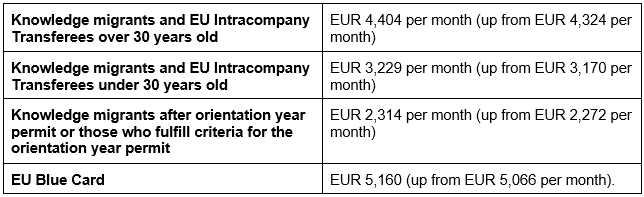
Employers should ensure they comply with the new salary requirements for initial and renewal applications filed on or after January 1, 2018
Additional requirements
- Benefits and allowances. Benefits and allowances may only be included if they are:
- specified in the employment contract or assignment letter;
- are guaranteed and fixed;
- are not paid in kind;
- are received on a monthly basis; and
- holiday allowance is not considered part of the salary for immigration purposes.
- Market salary rate. As an additional requirement, foreign nationals must also be paid at a similar rate as local employees in the same position.
- Currency. Employers are required to guarantee the salary in Euro regardless of payroll location and/or exchange rate fluctuations.
- EU Intracompany Transferees. The salary threshold applies to managers and specialists. A salary under the threshold is allowed if it meets the market salary rate, but will automatically trigger a market conformity check, where the labor authorities check whether the foreign worker’s salary is similar to that of a local employee in the same position. This could take up to an additional five weeks
- Fulfilling criteria of orientation year permit. As this is referred to above, foreign nationals who fulfill the requirements of the orientation year permit include foreign nationals who graduated from a Dutch university in the last three years; were scientific researchers or obtained a PhD in the Netherlands; or those who graduated from a top 200 university (per the Times Higher Education Work University Rankings; QS World University Rankings; and/or Academic Ranking of World Universities).
Government filing fee increases
Effective January 1, 2018, government filing fees will increase as follows:
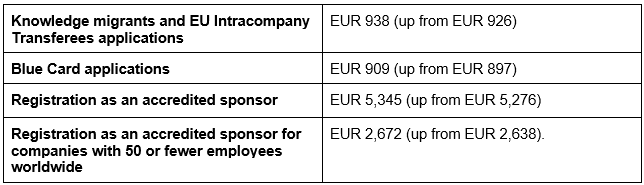
This shows a typical annual increase in fees.
This alert is for informational purposes only. If you have any questions, please contact the global immigration professional with whom you work at Fragomen or send an email to [email protected].

Explore more at Fragomen
Blog post
Manager Adam Hickling, Senior Associate Veronica Ciocea and Immigration Consultant Daisy Dale analyse the UK government’s A Fairer Pathway to Settlement consultation and its potential implications for the aviation sector, including proposed changes to Indefinite Leave to Remain, settlement timelines and dependant eligibility.
Media mentions
Partner Parisa Karaahmet discusses how recent US immigration policy changes, including potential impacts on the H-1B lottery, are shaping employer planning.
Media mentions
Media mentions
Partners Isha Atassi and Rahul Soni discuss US investment-based immigration options for Middle Eastern investors.
Blog post
Partner Ali Haider, Director Shoaib Khaleeli, Manager Ruaida Hussein and Senior Immigration Consultant Katerina Hornickova examine why degree equivalency has become mandatory in the United Arab Emirates and how the process affects employment, professional licensing and visa eligibility.
Video
Senior Associate Isabel Schnitzler explains key eligibility requirements for naturalization in Germany, including residence, language proficiency and financial self-sufficiency, as well as family eligibility considerations.
Media mentions
Partner Bo Cooper explains the impact of wage‑weighted selection on H‑1B registration and compliance.
Media mentions
Partner Aaron Blumberg explains how heightened government scrutiny affecting students from countries such as Venezuela is shaping travel guidance for those studying in the US.
Media mentions
Partner K. Edward Raleigh highlights how recent H-1B changes are shaping employer compliance strategies.
Media mentions
Practice Leader Colm Collins explains that processing delays, shifting demand in information and communication technology (ICT) and renewal cycles contributed to last year’s drop in work permit approvals.
Media mentions
Partner Rick Lamanna examines current pressures on Canada’s immigration system, including processing delays, reduced admissions and policy uncertainty and the implications for applicants and employers.
Blog post
Manager Adam Hickling, Senior Associate Veronica Ciocea and Immigration Consultant Daisy Dale analyse the UK government’s A Fairer Pathway to Settlement consultation and its potential implications for the aviation sector, including proposed changes to Indefinite Leave to Remain, settlement timelines and dependant eligibility.
Media mentions
Partner Parisa Karaahmet discusses how recent US immigration policy changes, including potential impacts on the H-1B lottery, are shaping employer planning.
Media mentions
Media mentions
Partners Isha Atassi and Rahul Soni discuss US investment-based immigration options for Middle Eastern investors.
Blog post
Partner Ali Haider, Director Shoaib Khaleeli, Manager Ruaida Hussein and Senior Immigration Consultant Katerina Hornickova examine why degree equivalency has become mandatory in the United Arab Emirates and how the process affects employment, professional licensing and visa eligibility.
Video
Senior Associate Isabel Schnitzler explains key eligibility requirements for naturalization in Germany, including residence, language proficiency and financial self-sufficiency, as well as family eligibility considerations.
Media mentions
Partner Bo Cooper explains the impact of wage‑weighted selection on H‑1B registration and compliance.
Media mentions
Partner Aaron Blumberg explains how heightened government scrutiny affecting students from countries such as Venezuela is shaping travel guidance for those studying in the US.
Media mentions
Partner K. Edward Raleigh highlights how recent H-1B changes are shaping employer compliance strategies.
Media mentions
Practice Leader Colm Collins explains that processing delays, shifting demand in information and communication technology (ICT) and renewal cycles contributed to last year’s drop in work permit approvals.
Media mentions
Partner Rick Lamanna examines current pressures on Canada’s immigration system, including processing delays, reduced admissions and policy uncertainty and the implications for applicants and employers.


