The situation
Effective January 1, 2019, the minimum salary for foreign workers in Croatia has increased as follows:
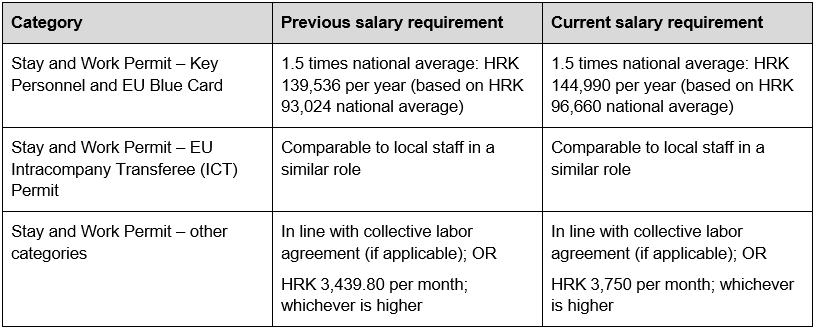
Although there is no formal salary requirement for the short-term Confirmation on Work category, it may be advisable to guarantee the local minimum wage (now HRK 3,750 per month) depending on the circumstances of the case.
A closer look
- Existing employees. Employers of foreign nationals must increase the foreign national’s salary to comply with the new rule.
- Initial and renewal applications. Employers of foreign nationals seeking to obtain or renew work authorization on or after January 1, 2019 must increase the foreign national’s salary to comply with the new rule. Immigration applications that do not meet the minimum salary will be refused.
- Pending applications. Employers of foreign nationals with pending work authorization applications as of January 1, 2019 must increase the foreign national’s salary to comply with the new rule. Immigration applications that do not meet the minimum salary will be refused.
Reminders on other requirements
- Benefits and allowances. As before, benefits and allowances cannot be included in the minimum salary calculation.
- Local salary rate. As before, employers are required under labor law to pay equal salaries for equal work to both foreign and local staff. Consequently, salaries for foreign workers must meet the average local salary rate for the proposed position.
- Currency. As before, employers are required to guarantee the salary in HRK regardless of payroll location and/or exchange rate fluctuations.
Background
In 2017 and 2018, the minimum salary amount went up by five percent.
The minimum annual salary for Key Personnel and EU Blue Card applicants is based on the average gross salary paid in Croatia the previous year, therefore, the increase for these categories occurred when the data from 2017 was made available by the Statistics Bureau in March of 2018.
Looking ahead
The above thresholds are based on average salaries over 2017. The average salaries over 2018 are expected to be published in a few months’ time. Salary requirements for foreign workers will be increased correspondingly in due time once again.
Most European countries have published their new salary thresholds over the past weeks. Countries that have not yet published threshold changes at this time are not expected to implement any changes shortly.
This alert is for informational purposes only. If you have any questions, please contact the global immigration professional with whom you work at Fragomen or send an email to [email protected].

Explore more at Fragomen
Work authorization
Senior Manager Katharina Vorländer examines how Germany’s strictly territorial migration and employment laws impact the deployment of third‑country nationals in offshore wind projects, highlighting compliance risks arising from maritime zone boundaries, work authorization limits and Schengen documentation challenges.
Work authorization
Senior Associate Tugba Ozyakup and Senior Immigration Manager Andreia Ghimis explore how the EU’s Entry/Exit System is reshaping Schengen overstay enforcement, the risks facing travellers and employers and the legal remedies available to challenge or prevent adverse outcomes.
Video
Partner Rick Lamanna, Senior Associate Jake Paul Minster and Senior Manager Sergio Flores discuss Canada’s entry requirements for the 2026 FIFA World Cup, including visa-required and visa-exempt nationals, visitor entry rules and key planning considerations for fans, teams, media and volunteers.
Media mentions
Partner Kevin Miner discusses the DOL’s proposed H-1B wage rule and its potential to add significant unplanned costs for US employers.
Media mentions
Video
Senior Associate Isabel Schnitzler highlights key pathways to German citizenship, including descent-based eligibility and standard naturalization requirements and outlines important considerations for individuals exploring their options.
Media mentions
Senior Manager Louise Senior outlines key compliance considerations for UK hospitality sponsors as regulatory expectations continue to evolve.
Media mentions
Senior Counsel Mitch Wexler said proposed H-1B and PERM wage increases could raise hiring costs and apply only to new and pending applications.
Work authorization
UK Government Affairs Strategy Director Shuyeb Muquit explores the latest UK immigration fee increases and their wider implications for migration trends, labour supply and workforce planning.
Video
Partner Karine Wenger outlines US visa considerations for the 2026 FIFA World Cup, including the FIFA Pass priority scheduling system and the importance of early planning.
Media mentions
Video
Senior Associate Isabel Schnitzler highlights key considerations for managing outbound assignments from Germany, including planning, visa requirements and coordinated global support.
Work authorization
Senior Manager Katharina Vorländer examines how Germany’s strictly territorial migration and employment laws impact the deployment of third‑country nationals in offshore wind projects, highlighting compliance risks arising from maritime zone boundaries, work authorization limits and Schengen documentation challenges.
Work authorization
Senior Associate Tugba Ozyakup and Senior Immigration Manager Andreia Ghimis explore how the EU’s Entry/Exit System is reshaping Schengen overstay enforcement, the risks facing travellers and employers and the legal remedies available to challenge or prevent adverse outcomes.
Video
Partner Rick Lamanna, Senior Associate Jake Paul Minster and Senior Manager Sergio Flores discuss Canada’s entry requirements for the 2026 FIFA World Cup, including visa-required and visa-exempt nationals, visitor entry rules and key planning considerations for fans, teams, media and volunteers.
Media mentions
Partner Kevin Miner discusses the DOL’s proposed H-1B wage rule and its potential to add significant unplanned costs for US employers.
Media mentions
Video
Senior Associate Isabel Schnitzler highlights key pathways to German citizenship, including descent-based eligibility and standard naturalization requirements and outlines important considerations for individuals exploring their options.
Media mentions
Senior Manager Louise Senior outlines key compliance considerations for UK hospitality sponsors as regulatory expectations continue to evolve.
Media mentions
Senior Counsel Mitch Wexler said proposed H-1B and PERM wage increases could raise hiring costs and apply only to new and pending applications.
Work authorization
UK Government Affairs Strategy Director Shuyeb Muquit explores the latest UK immigration fee increases and their wider implications for migration trends, labour supply and workforce planning.
Video
Partner Karine Wenger outlines US visa considerations for the 2026 FIFA World Cup, including the FIFA Pass priority scheduling system and the importance of early planning.
Media mentions
Video
Senior Associate Isabel Schnitzler highlights key considerations for managing outbound assignments from Germany, including planning, visa requirements and coordinated global support.