Fragomen Report Highlights Global Worker Shortfall of 85 Million by 2030
January 21, 2026

NEW YORK, January 21, 2026 — Rising global mobility costs are pushing employers to rethink how they hire and relocate international talent in 2026, even as labor shortages persist, according to Fragomen’s 2026 Worldwide Immigration Trends Report covering more than 75 jurisdictions.
The report finds that global demand for skilled workers remains high, but increasing government immigration fees, rising salary thresholds and escalating living costs are tightening the financial and operational margin for international mobility decisions. These trends are unfolding alongside structural labor shortages driven by long‑term demographic decline, accelerated digital adoption and pandemic‑disrupted training pipelines — factors that continue to reshape labor markets worldwide.
Global snapshot: Talent shortages
- 74% of employers worldwide reported difficulty finding needed talent in 2025, double the global rate a decade earlier
- By 2030, the global economy faces a projected shortfall of 85 million workers
- The global talent gap represents an estimated $8.5 trillion in unrealized annual revenues
Rather than pulling back from cross-border hiring, employers globally are becoming more selective. Mobility decisions are shifting from operational planning to strategic investment as costs rise and tolerance for risk narrows. In many markets, sharply higher government filing fees and wage floors have moved mobility decisions from questions of scale to questions of feasibility. At the same time, significant increases in salary thresholds and expanding compliance obligations are further raising the cost of employing foreign talent.
Global snapshot: Cost of international mobility
- Average global employee relocation cost in 2025: approximately $77,000
- Long‑term international assignments exceeded $300,000 in some markets
- Cost increases reflect higher housing, education and government immigration fees
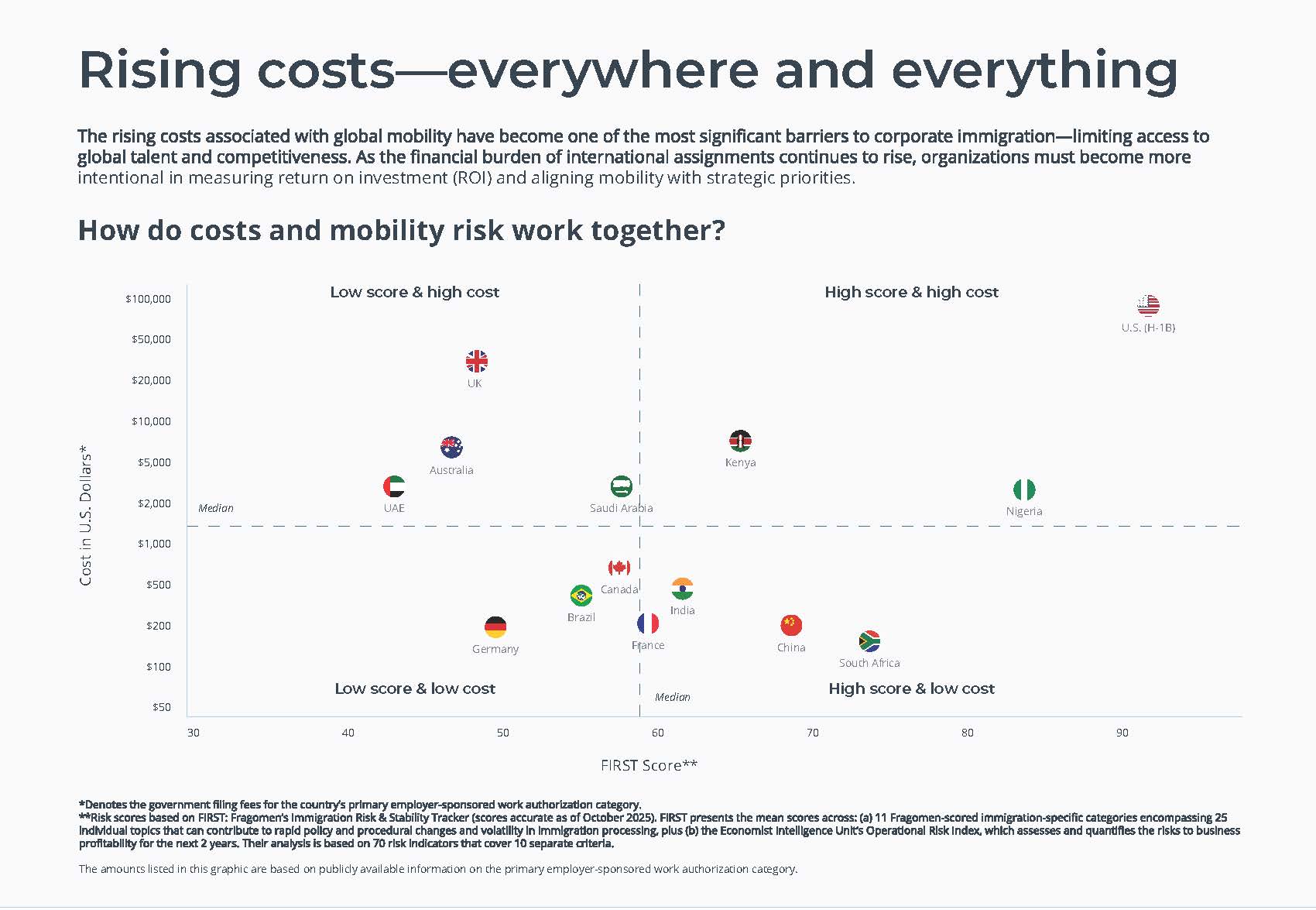 This graphic illustrates how government filing fees interact with immigration and mobility risk in key destination markets, helping employers assess where international placements offer the strongest balance of cost and process stability.
Despite rising costs, the report shows that global mobility remains critical to addressing structural skills shortages, supporting leadership development and enabling cross-border knowledge transfer when aligned with business priorities.
The report also highlights growing tension between efficiency and risk. While digital filing platforms and electronic travel authorizations have improved processing speed in some jurisdictions, inconsistent implementation and expanding reporting obligations have increased compliance exposure and potential delays worldwide. Fragomen’s report notes that while digital systems can accelerate decision-making, uneven rollout across jurisdictions and evolving verification requirements are increasing operational complexity for employers.
As employers refine their 2026 strategies, the report concludes that global mobility will be defined by sharper decision-making. With costs rising and talent shortages deepening, employers are expected to place greater emphasis on precision hiring, data-driven cost analysis and more targeted use of international assignments to sustain access to global talent.
The full Fragomen 2026 Worldwide Immigration Trends Report is available here.
About Fragomen
Fragomen is the leading global immigration law firm with more than 6,000 professionals across more than 70 offices across the Americas, EMEA and Asia Pacific, delivering services in over 170 countries. Ranked on both the Am Law 100 and Am Law Global 100, the firm is widely recognized for its leadership in immigration law and commitment to fostering a culture where diverse attorneys thrive and all individuals have equal opportunities to succeed.
Fragomen helps corporations and individuals navigate the complexities of global mobility and provides end-to-end support across the immigration lifecycle, from strategic planning and policy design to compliance, government investigations, litigation and more. The firm combines legal acumen and advanced digital capabilities to simplify global mobility and deliver smarter, faster and more adaptive solutions via a suite of technology brands—including Nomadic, its business travel platform that enables real-time compliance, WorkRight, its multi-jurisdictional employment verification software and Simple Citizen, a digital solution designed to streamline the pathway to US citizenship.
With a global presence, multidisciplinary approach and investment in technology, Fragomen is uniquely positioned to address today’s immigration challenges and shape the future of workforce mobility.
Media Contacts:
Ela Friel, Managing Director of Communications and Public Relations
+1 301 785 4306
[email protected]

