
The situation
Effective January 1, 2019, the minimum monthly salary for foreign workers in Portugal has increased as follows, up 3.4 percent from last year:
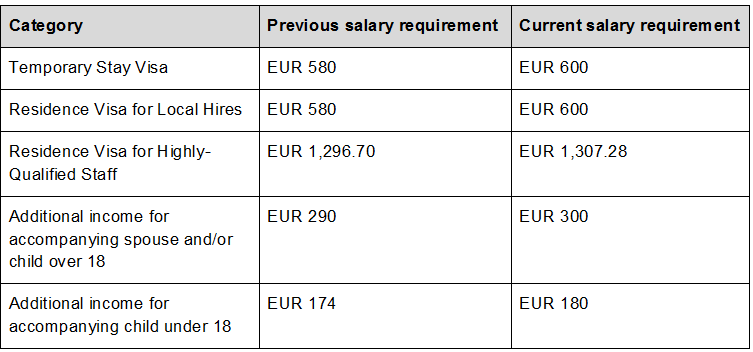
Note that Residence Visa for Highly-Qualified Staff applicants must receive a salary at 1.2-1.5 times the average gross salary, in addition to the above salary requirement. The average gross salary amounts are however rarely published. Fragomen advises that the salary amount is set at least to EUR 1,700 to maintain a safe margin above the EUR 1,307.28 amount.
A closer look
- Existing employees. Employers of foreign nationals must increase the foreign national’s salary to comply with the new rule if required.
- Initial and renewal applications. Employers of foreign nationals seeking to obtain or renew a visa on or after January 1, 2019 must increase the foreign national’s salary to comply with the new rule. Immigration applications that do not meet the minimum salary will be refused.
- Pending applications. Employers of foreign nationals with pending visa applications as of January 1, 2019 must increase the foreign national’s salary to comply with the new rule. Immigration applications that do not meet the minimum salary will be refused.
Reminders on other requirements
- Benefits and allowances. As before, benefits and allowances can only be included for foreign workers on home contract. For those applicants, cost of living and housing allowances can be included in the calculation, provided that these are transferred to the foreign national’s bank account, paid monthly, taxable, processed via payroll, guaranteed and fixed.
- Salary prorating. As before, salary cannot be prorated except in the first and last month of employment or assignment.
- Currency. As before, employers are required to guarantee the salary in EUR regardless of payroll location and/or exchange rate fluctuations.
Background
Portugal increased salary requirements by 5.1 percent for 2017 and 4.1 percent for 2018. Salary increases between one and five percent are typical in the region and are implemented annually.
Looking ahead
Croatia, Israel, Latvia and Slovenia are expected to announce new salary thresholds in the coming weeks.
This alert is for informational purposes only. If you have any questions, please contact the global immigration professional with whom you work at Fragomen or send an email to [email protected].

Explore more at Fragomen
Video
Director David Iannella discusses how Global Entry can help frequent business travelers navigate US entry more predictably and access TSA PreCheck.
Immigration analysis
Manager Konstantin Schmid provides a practical overview of Swiss citizenship routes, eligibility rules and common reasons applications are delayed or refused.
Media mentions
Manager Pierangelo D’Errico discusses how recent changes to Italy’s citizenship rules are affecting applicants with Italian ancestry.
Podcast
Director Laxmi Limbani discusses how women are shaping the global space sector, the barriers they face and what is needed to support a more inclusive space workforce.
Media mentions
Senior Manager William Diaz outlines how immigration changes in the US and UK may affect workforce planning and mobility for the games industry in 2026.
Media mentions
Partner Julia Onslow-Cole highlights how global mobility is becoming a strategic, board-level consideration requiring careful planning, compliance and workforce management.
Video
Director Fatima Aydin outlines Ireland’s roadmap for increasing minimum annual remuneration salary thresholds and the implications for employer workforce planning and compliance.
Video
In this episode of the Fragomen FC, Partner Rick Lamanna, Senior Manager Jake Paul Minster, Manager Gustavo Kanashiro and Manager Sergio Flores discuss how immigration systems across the Americas shape football mobility, compliance and cross-border movement throughout South America.
Blog post
Senior Associate Ruben Fiedler outlines the new employer information obligation under Section 45c of the German Residence Act, explaining when it applies, what employers must provide to third-country nationals recruited from abroad and the practical steps needed to ensure compliance from 1 January 2026.
Podcast
Partners Cosmina Morariu and Rahul Soni examine how immigration and global mobility trends are influencing workforce strategy across the luxury sector.
Blog post
UK Government Affairs Strategy Director Shuyeb Muquit compares the EU’s new Visa Strategy with the UK’s post-Brexit immigration system and assesses what the UK can learn to remain competitive for global talent.
Media mentions
Partner Karolina Schiffter highlights that new electronic signature rules may delay work permit procedures for foreign workers in Poland.
Video
Director David Iannella discusses how Global Entry can help frequent business travelers navigate US entry more predictably and access TSA PreCheck.
Immigration analysis
Manager Konstantin Schmid provides a practical overview of Swiss citizenship routes, eligibility rules and common reasons applications are delayed or refused.
Media mentions
Manager Pierangelo D’Errico discusses how recent changes to Italy’s citizenship rules are affecting applicants with Italian ancestry.
Podcast
Director Laxmi Limbani discusses how women are shaping the global space sector, the barriers they face and what is needed to support a more inclusive space workforce.
Media mentions
Senior Manager William Diaz outlines how immigration changes in the US and UK may affect workforce planning and mobility for the games industry in 2026.
Media mentions
Partner Julia Onslow-Cole highlights how global mobility is becoming a strategic, board-level consideration requiring careful planning, compliance and workforce management.
Video
Director Fatima Aydin outlines Ireland’s roadmap for increasing minimum annual remuneration salary thresholds and the implications for employer workforce planning and compliance.
Video
In this episode of the Fragomen FC, Partner Rick Lamanna, Senior Manager Jake Paul Minster, Manager Gustavo Kanashiro and Manager Sergio Flores discuss how immigration systems across the Americas shape football mobility, compliance and cross-border movement throughout South America.
Blog post
Senior Associate Ruben Fiedler outlines the new employer information obligation under Section 45c of the German Residence Act, explaining when it applies, what employers must provide to third-country nationals recruited from abroad and the practical steps needed to ensure compliance from 1 January 2026.
Podcast
Partners Cosmina Morariu and Rahul Soni examine how immigration and global mobility trends are influencing workforce strategy across the luxury sector.
Blog post
UK Government Affairs Strategy Director Shuyeb Muquit compares the EU’s new Visa Strategy with the UK’s post-Brexit immigration system and assesses what the UK can learn to remain competitive for global talent.
Media mentions
Partner Karolina Schiffter highlights that new electronic signature rules may delay work permit procedures for foreign workers in Poland.

