Executive Summary
On September 25, 2017, updated wage information was released and went into effect, creating new prevailing wages for many industries in Canada.
The situation
The Canadian government updated the prevailing wage for many industries.
A closer look
On September 25, 2017, the Canadian government released updated wage information for occupations in numerous industries. Applications filed on or after September 25 must meet the updated wage requirements.
Background
Many work permit categories require that a foreign national be paid the prevailing wage, which is the median wage as established by Employment and Skills Development Canada/Service Canada (ESDC), as a minimum requirement for eligibility for a work permit.
Failure to comply with the prevailing wage may result in compliance issues for employers of foreign nationals in Canada.
Impact on pending applications
Pending work permit and Labour Market Impact Assessment (LMIA) applications may also be impacted by this change; employers may receive requests to adjust the wage offered to a foreign national prior to visa issuance.
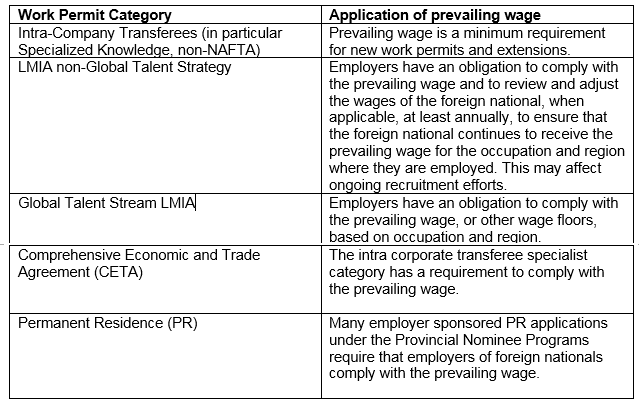
Implications for employers
The prevailing wage has increased for many occupation categories. Employers should review their foreign worker population for compliance with the updated wage requirements. Fragomen can assist with this review.
This alert is for informational purposes only. If you have any questions, please contact the global immigration professional with whom you work at Fragomen or send an email to [email protected] .

Explore more at Fragomen
Blog post
Media mentions
Senior Associate Isabel Schnitzler outlines the key compliance considerations for employers with employees working across the EU.
Podcast
Associates Stephanie D. Weaver and Julia Manacher examine immigration issues emerging in a popular reality television series, including K-1 visa denials, consular non-reviewability, fraud findings and changing adjudication policies.
Blog post
Manager Dr. Adela Schmidt examines common misconceptions in German citizenship law, including birthright citizenship, dual citizenship, citizenship by descent and naturalization processing, and explains why eligibility often depends on specific legal requirements, timelines and documentation.
Awards
Partner Audrea Golding, Senior Associate Kyle Sommer and Senior Talent Development Director Wendy Milici have been named finalists in the 2026 TLC Lions Human Awards Americas, recognizing their contributions to human-centered leadership, workplace culture and inclusion.
Media mentions
Fragomen and SICPA have launched a global joint venture to develop an end-to-end digital identity platform that enables secure identity verification, document authentication and verifiable credential management.
Media mentions
Senior Counsel Mitch Wexler discusses how potential changes to H-1B visas, employment-based green cards and OPT could impact employers’ workforce planning and compliance obligations.
Media mentions
In a Leaders in Motion interview with World Business Travel Forum, Partner Ali Haider and Nomadic CEO Carsten Østberg discuss recent travel and mobility developments across the Middle East and practical considerations for employers managing cross-border talent in the region.
Media mentions
Partner Rachel Beardsley explains how new DHS guidance clarifies that dairy employers may use the H-2A program when they can demonstrate a temporary or seasonal labor need.
Fragomen news
Fragomen and SICPA announced the formation of a global joint venture to advance next-generation digital identity solutions for governments, enterprises and individuals.
Blog post
Senior Associate Kyle Sommer and Adam Schwartz, Director in the Global Mobility practice at Andersen, discuss how immigration and tax considerations intersect across common US immigration classifications and why early coordination can help travelers, employers and advisors reduce compliance risks and make more informed mobility decisions.
Blog post
Media mentions
Senior Associate Isabel Schnitzler outlines the key compliance considerations for employers with employees working across the EU.
Podcast
Associates Stephanie D. Weaver and Julia Manacher examine immigration issues emerging in a popular reality television series, including K-1 visa denials, consular non-reviewability, fraud findings and changing adjudication policies.
Blog post
Manager Dr. Adela Schmidt examines common misconceptions in German citizenship law, including birthright citizenship, dual citizenship, citizenship by descent and naturalization processing, and explains why eligibility often depends on specific legal requirements, timelines and documentation.
Awards
Partner Audrea Golding, Senior Associate Kyle Sommer and Senior Talent Development Director Wendy Milici have been named finalists in the 2026 TLC Lions Human Awards Americas, recognizing their contributions to human-centered leadership, workplace culture and inclusion.
Media mentions
Fragomen and SICPA have launched a global joint venture to develop an end-to-end digital identity platform that enables secure identity verification, document authentication and verifiable credential management.
Media mentions
Senior Counsel Mitch Wexler discusses how potential changes to H-1B visas, employment-based green cards and OPT could impact employers’ workforce planning and compliance obligations.
Media mentions
In a Leaders in Motion interview with World Business Travel Forum, Partner Ali Haider and Nomadic CEO Carsten Østberg discuss recent travel and mobility developments across the Middle East and practical considerations for employers managing cross-border talent in the region.
Media mentions
Partner Rachel Beardsley explains how new DHS guidance clarifies that dairy employers may use the H-2A program when they can demonstrate a temporary or seasonal labor need.
Fragomen news
Fragomen and SICPA announced the formation of a global joint venture to advance next-generation digital identity solutions for governments, enterprises and individuals.
Blog post
Senior Associate Kyle Sommer and Adam Schwartz, Director in the Global Mobility practice at Andersen, discuss how immigration and tax considerations intersect across common US immigration classifications and why early coordination can help travelers, employers and advisors reduce compliance risks and make more informed mobility decisions.