United States: USCIS Announces H-1B Cap Registration Schedule for FY 2027
January 30, 2026

Country / Territory

Share
At a glance
- The FY 2027 H-1B cap registration period will open at noon ET on March 4, 2026 and will close at noon ET on March 19, 2026. All cap registrations must be drafted and submitted online during this period.
- After registration closes, USCIS will conduct the FY 2027 H-1B cap selection and notify all sponsoring employers of selected beneficiaries by March 31, 2026.
- USCIS is expected to begin accepting H-1B petitions on April 1, 2026. The petition filing period will remain open for a minimum of 90 days.
- New this year, USCIS will implement a wage-based weighted system for H-1B cap lottery selection and may impose a $100,000 fee at the H-1B petition stage for consular notification petitions. Employers should work closely with counsel in preparing for these changes.
The issue
Sponsoring employers may submit registrations for the FY 2027 H-1B cap between noon ET on March 4, 2026, and noon ET on March 19, 2026, USCIS has announced. USCIS will notify employers and representatives of selected foreign nationals by March 31, 2026. For the third consecutive year, USCIS will use a beneficiary-centric registration selection system, meaning a random computerized lottery will select the unique foreign national beneficiaries, rather than the individual employer registrations, for which an H-1B cap petition may be submitted.
For the first time this year, however, unique beneficiaries will be selected based on a new wage-based weighted system, as described below. In addition, if a foreign national is selected in the cap lottery, but a change of status H-1B petition cannot be approved for them, a new $100,000 fee would be required of the petitioning employer. Further information on both of these changes is noted below as well as addressed in detail in this recent client alert FAQ.
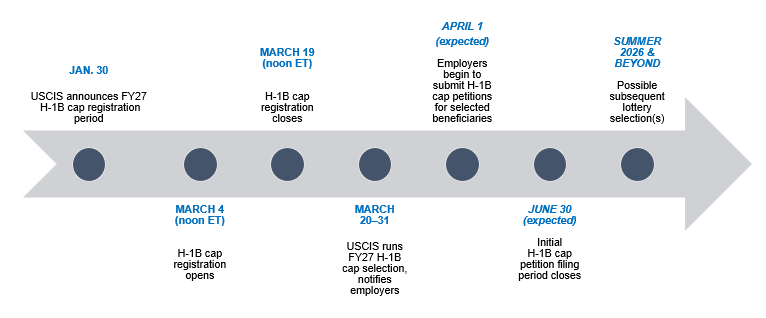
A timeline of the FY 2027 H-1B cap process is outlined here.
Registering for the FY 2027 H-1B cap
USCIS will once again use an online registration system to conduct the H-1B cap selection. An employer account is necessary whether your organization will work with immigration counsel to submit registrations or will submit registrations on its own behalf. Your organization’s accounts must be maintained by an employee authorized to sign immigration benefit requests for your organization.
USCIS uses an organizational account system that allows multiple people within an organization and their immigration counsel to collaborate on and prepare H-1B registrations. If your organization will be represented by immigration counsel during the registration process, you or your attorney will be able to associate your organization’s account with its attorneys’ accounts.
Organizational and representative user accounts may be created or upgraded at any time. Because the system is complex, new users of the system and their counsel should carefully plan in advance before upgrading or creating new accounts. In the coming weeks, USCIS may issue updated instructions on any enhancements organizational accounts to the system, but at this time, the system is expected to operate in the same manner as last year.
Cap registration opens March 4, 2026
Employers and their immigration counsel can begin to draft, review, sign, and submit cap registrations when the registration system opens on Wednesday, March 4, 2026, at noon ET. The USCIS system will not accept drafts or registrations before March 4.
The registration period will close on Thursday, March 19, 2026 at noon ET. All registrations for the FY 2027 cap must be submitted by this time. Late registrations will not be accepted.
The H-1B cap lottery: beneficiary-centric with new weighted lottery system
The H-1B cap registration system will again use beneficiary-centric selection, rather than the registration-centric selection method that had been in effect before FY 2025. Under the beneficiary-centric system, a foreign national’s passport or valid travel document will be required for an H-1B cap registration submission on their behalf. The passport or travel document will be used as the beneficiary’s unique identifier, serving as the means for selection in the H-1B cap lottery. Foreign nationals must use the same passport or travel document as an identifier for all of the registrations submitted on their behalf; if they are registered under more than one document, all of their registrations can be invalidated.
New this year, however, the Department of Homeland Security is replacing the longstanding random H-1B cap lottery process with a new weighted lottery that increases the odds of selection for foreign nationals being offered the highest wages according to the Department of Labor’s four-level Occupational Employment and Wage Statistics (OEWS) prevailing wage system. When an employer registers a beneficiary for the FY 2027 cap, the employer will be required to state the OEWS wage level to which the offered salary corresponds for that occupation and geographic area of employment. A beneficiary whose offered wage corresponds to Level 4 (the highest tier) of the four-level OEWS wage structure will be entered into the selection pool four times. A Level 3 beneficiary will be entered three times; a Level 2 beneficiary, two times; and a Level 1 beneficiary, once. Employers should work closely with counsel in determining the proper wage level required for the H-1B cap registration.
As in past years, USCIS is expected to receive far more H-1B cap registrations than needed to meet the annual quota of 85,000. At the end of the registration period, USCIS will conduct two lotteries to select enough beneficiaries to meet the 85,000 annual cap. The first lottery will include all registered beneficiaries and will select enough to meet the regular cap of 65,000. The second lottery includes registered U.S. advanced-degree holders who were not chosen in the first lottery and would select enough to meet the advanced-degree cap exemption of 20,000.
USCIS plans to notify employers and immigration counsel of winning beneficiaries by March 31, 2026. If a beneficiary is selected, each potential employer that filed a bona fide registration on that beneficiary’s behalf will be notified and each of those employers will be eligible to file an H-1B petition for the beneficiary. USCIS will provide a selection notice for each winning beneficiary. The selection notice is valid for the named beneficiary only; employers cannot substitute beneficiaries.
The petition filing period
USCIS is expected to begin accepting H-1B cap petitions for selected beneficiaries on Wednesday, April 1, 2026. The petition filing period must remain open for at least 90 days.
Employers can file their petitions at any time during this period, but some cases might need to be filed by a specific date within the filing window. For example, an F-1 student with an optional practical training (OPT) employment authorization document (EAD) that expires before the end of the filing period must have their cap petition filed before the OPT EAD expiration date to ensure cap-gap work authorization benefits through the start date of their H-1B cap petition or April 1, 2027 (whichever is earlier). Your organization should work with your Fragomen team to identify beneficiaries with time-sensitive filing needs.
USCIS will again offer the option of online filing of cap and non-cap H-1B petitions and associated premium processing requests. However, because online filing remains unpredictable in the scope and scale needed for the high volume of H-1B petitions and has other limitations and potential risks, employers should carefully consider with their immigration counsel whether it is advisable. Hard-copy submission remains USCIS’s predominant method of H-1B petition case filing.
Impact of the $100,000 H-1B fee on cap season
New this year, prospective employers are reminded that if an H-1B change of status request cannot be approved for a foreign national – for example, a change of status request from F-1 or L-1 to H-1B – and the H-1B petition can only be approved for consular notification, the petition will be subject to a $100,000 fee in order for the H-1B cap petition to be approved, unless the employer has sought and obtained a national interest exception (NIE) to the new fee. Though liability for the $100,000 H-1B fee does not affect whether a candidate can be registered for the lottery, employers may want to assess whether they may be subject to the fee before registering a candidate.
What employers should do now
Employers should work with their immigration counsel to identify H-1B cap needs, gather beneficiary data, and familiarize themselves with new requirements as soon as possible. Early preparation is especially crucial because the new wage-weighted lottery requires advance analysis for each registration. Your organization should also work with your Fragomen team to begin to gather supporting documentation and information required for the H-1B cap season; advance preparation can minimize the risk of delay during the busy registration and petition filing periods. However, because USCIS is expected to implement a revised version of Form I-129 in connection with the new weighted selection rule, advance petition preparation on the current Form I-129 version is likely not advised.
Employers should also work closely with prospective FY 2027 H-1B cap beneficiaries to ensure they have valid passports or travel documents, that they are aware of the parameters of the beneficiary-centric system, and that their histories with law enforcement or immigration authorities are not expected to present challenges in the approval of an H-1B change of status request.
Fragomen is closely monitoring the USCIS cap registration process and will provide updates throughout the FY 2027 cap season.
This alert is for informational purposes only. If you have any questions, please contact the immigration professional with whom you work at Fragomen.

