Federal Immigration Agencies Release Spring 2020 Regulatory Agendas
July 1, 2020

Country / Territory

Share
At a Glance
- The Department of Homeland Security is continuing to move forward with plans to rescind the H-4 employment authorization program, revise H-1B eligibility criteria, and toughen rules related to business visitors, and to foreign student periods of stay and practical training, among others.
- Both DHS and the State Department have plans to increase filing fees, with a sweeping USCIS fee rule scheduled for publication this fall.
- Some key proposals in prior regulatory agendas have been moved to the DHS “long-term action” list, indicating they are of lesser priority at this time. These include plans related to the EB-5 immigrant investor program and L-1 nonimmigrant program, among others.
- The agenda is being released in the wake of a presidential proclamation that directs DHS and the State Department to issue regulations ensuring that the presence of certain foreign workers does not disadvantage U.S. workers.
The issue
The Departments of Homeland Security and State have announced their Spring 2020 regulatory agendas, which reveal each agency’s rulemaking priorities for the coming months. When and if finalized, these rules could significantly impact the H-1B, H-4 employment authorization, business visitor, and foreign student programs, among other programs and processes.
The regulatory agendas come in the wake of President Trump’s recent proclamation to restrict nonimmigrant entry. In that proclamation, the President ordered the Departments of Homeland Security, State and Labor to consider issuing regulations to ensure that H-1B nonimmigrants and EB-2 and EB-3 immigrants, among others, do not disadvantage U.S. workers.
The following summarizes key employment-based items on the agencies’ immigration agendas. In all cases, the details of proposed and final regulations are confidential until released for publication. Projected publication dates are subject to change. While agencies routinely miss regulation publication target dates, it is also possible for them to fast-track at least some regulations under certain circumstances, particularly in light of President Trump’s recent orders. The regulatory process is detailed below.
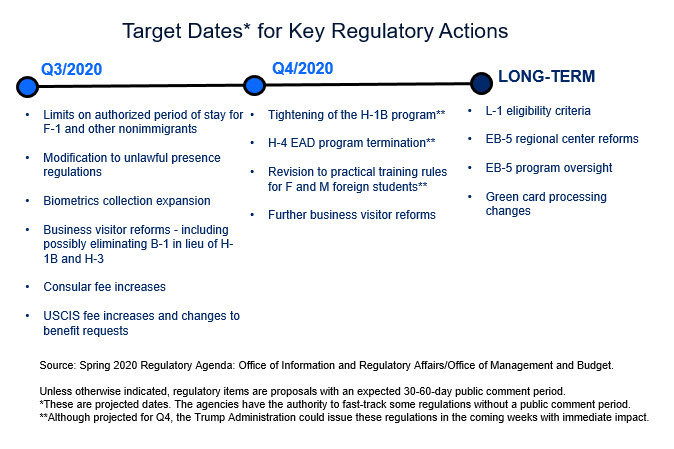
Tightening of the H-1B program; termination of H-4 employment authorization
DHS continues to move forward with a long-planned proposal to revise the definition of an H-1B specialty occupation to “increase focus on obtaining the best and brightest foreign nationals.” The H-1B rule is expected to revise the definitions of “employment” and “employer-employee relationship,” with a likely focus on restriction of offsite placement of H-1B workers. The proposal is also anticipated to address H-1B wages and a new method of allocation of H-1B cap numbers to give priority to the highest-paid beneficiaries.
Originally slated to be published for public comment in August 2019, it is now officially projected for December 2020. However, there are indications that the Trump Administration may issue these regulations in the coming weeks as interim final rules with immediate impact, following the Administration’s proclamation restricting nonimmigrant entry. If this occurs, employers and other members of the public would not have an opportunity to provide public feedback before the rule took effect.
A long-deferred proposal to rescind a program that permits certain H-4 spouses to apply for employment authorization is now projected to be published in September 2020. It is currently under review at the Office of Management and Budget. The details of the proposed rule – including whether currently valid H-4 EADs will remain valid until their expiration – are not yet known.
Limits and restrictions on foreign student periods of stay and practical training
Immigration and Customs Enforcement’s proposal to revise practical training rules for F and M foreign students is now slated for publication in December 2020. The proposal is expected to seek restrictions on 12-month optional practical training (OPT), STEM OPT extensions, and curricular practical training (CBP). It is possible, however, that in light of the recent presidential proclamation, DHS may seek to fast-track this rule in some way.
In addition, a proposal by ICE to modify the period of authorized stay for certain F-1 and other nonimmigrants from duration of status (D/S) to a specified end date, is scheduled for publication in July 2020. Currently, foreign nationals with a D/S period of authorized stay are permitted to remain in the United States until the end of their authorized activity (plus any applicable grace period), whichever date that may be.
Limits and new requirements for business visitors
B visitor criteria and period of stay: The State Department is continuing its plans to propose rules affecting the business visitor category. Two separate rules seek to change current policy in some respects, possibly by restricting permissible business visitor activities. These restrictions could include the elimination of policies that allow B-1 visitors to engage in work in the United States in limited circumstances; one of the rules would appear to eliminate the use of B-1 in lieu of the H-1B and H-3 classifications. That rule was slated to be published in June 2020. The more general B-1/B-2 policy rule has been delayed for publication until October 2020.
Alongside the State Department proposals, DHS also continues to propose a rule to ensure a more rigorous implementation of the B-1/B-2 business or tourist visitor visa classification. This proposed regulation was slated for June 2020 but has been delayed further. It is expected to modify the period of B visitor admission and extensions of stay.
ESTA for Visa Waiver land travel: DHS intends to implement ESTA for use of the Visa Waiver Program for travel over land borders through an interim final rule scheduled for June 2020. As an interim final rule, the change would take effect immediately upon publication. ESTA is currently only implemented for travel and entry to the United States by air or at sea ports.
New pilot bond program: The State Department plans to issue a new interim final rule that creates a bond pilot program in connection with B-1/B-2 visa issuance in July 2020. Again, as an interim final rule, it could take effect upon publication or very shortly thereafter. Under the pilot program, consular officers would require certain individuals applying for B-1/B-2 visas to post a bond ensuring maintenance of status and departure as a condition to obtain the B visa.
Consequences of nonimmigrant status violations
DHS continues to seek to codify policies concerning accrual of unlawful presence and the three- and ten-year bars to admissibility, but has delayed a proposed rule publication date to March 2021. One element of this proposal could cause foreign nationals to accrue unlawful presence if they violate the terms of their nonimmigrant stay, such as engaging in additional employment or other activities that are not permitted under the rules of the program under which they were admitted.
In the shorter term, DHS has proposed a new rule that would revise regulations relating to the provisional unlawful presence waiver some foreign nationals apply for prior to departing the United States for a consular interview. The rule is scheduled for publication in August 2020.
Biometrics requirements
Proposals relating to the collection of biometrics remain on the DHS agenda. A USCIS rule is re-scheduled for publication in July 2020, and the CBP version for June 2020. While not entirely clear what substantive changes might be included in these rules, there is likely to be an expansion of the agencies’ biometrics collection. The June 22 presidential proclamation includes biometrics as an area in which DHS is directed to take appropriate action to prevent improper admission and issuance of benefits.
Fee increases
Both DHS and the State Department continue with plans to increase their filing fees.
A final DHS fee rule that would increase filing fee costs for most petitioners and applicants is now scheduled for publication in September 2020. As originally proposed, the rule provided a weighted average fee increase of 21% across all benefits, and also made substantive changes to immigrant benefits processes. Proposed changes included lengthening the USCIS premium processing timeline by almost a week, and imposing additional fee requirements on employers with a high percentage of H-1B and L-1 employees, among others. It is not known whether these proposed changes are to be included in the final version. The fee increase regulation is progressing amid reports that USCIS is facing budget shortfalls and is seeking appropriations from Congress to ensure continued operations.
The State Department intends to increase consular filing fees, which includes nonimmigrant and immigrant visa applications. Its proposed fee rule, scheduled for June 2020, is already delayed almost a year from its initial projected publication date.
Deferral of anticipated EB-5, L-1 and green-card processing rules
DHS has moved some items from its Fall 2019 main regulatory agenda to the Spring 2020 “long-term action” list. This indicates that these proposed rules have been temporarily de-prioritized by the agency. They could, however, return to the main agenda list as soon as this fall or any time thereafter:
- L-1 program changes: A new L-1 proposal that had been slated for publication in September 2020 has now been moved to DHS’s long-term plans. As described, the proposal would redefine L-1B specialized knowledge, as well as L-1 employment and employer-employee relationships. It would also likely further restrict offsite placement of L-1 employees.
- Green card processing: A proposal to change the way adjustment of status applications are processed has also moved from the main agenda. The proposal seeks to discontinue the concurrent filing of adjustment of status applications with Form I-140 employment-based immigrant visa petitions and other preference petitions. This action would delay the filing of applications for adjustment-based employment authorization and advance parole documents.
- EB-5 program changes: Two regulatory items related to the EB-5 program have also been moved to longer term planning. A proposal to change the way EB-5 Regional Centers are designated, and an advance notice of proposed rulemaking to seek public comments on the monitoring and oversight of the EB-5 program have both been deferred for now.
What’s ahead: the regulatory timeline and impact on current immigration programs
Agency regulatory agendas do not have an immediate effect on current programs, but are the clearest indication of the Trump Administration’s continued plans to restrict the H-1B, H-4 EAD and foreign student programs, among others.
The Administration is planning to implement at least some new regulations on a fast track, with immediate or near-immediate implementation and no opportunity for advance public feedback. These are known as interim final rules, and they are permitted if the federal agency can demonstrate good cause. If new interim final rules are imposed, they could be challenged in court.
If the Administration follows standard rulemaking procedures, regulations would first be published in proposal form, with a 30- to 60-day public feedback period. Such rules could only be implemented after the Administration gives meaningful consideration to the feedback it receives and then clears a review by the Office of Management and Budget. The normal rulemaking process takes at least several months. It is not clear whether the Administration would be able to finalize regulations under the standard process before the presidential elections later this year.
Fragomen is closely monitoring the progress of anticipated regulations. If your organization wishes to comment or advocate in connection with a regulation, please contact your designated Fragomen professional or the firm’s Government Strategies and Compliance Group.
This alert is for informational purposes only. If you have any questions, please contact the immigration professional with whom you work at Fragomen.

