December 2015 Visa Bulletin: Final Action Date Advances Significantly for EB-2 India; No Movement in Filing Eligibility Dates
November 9, 2015

Country / Territory
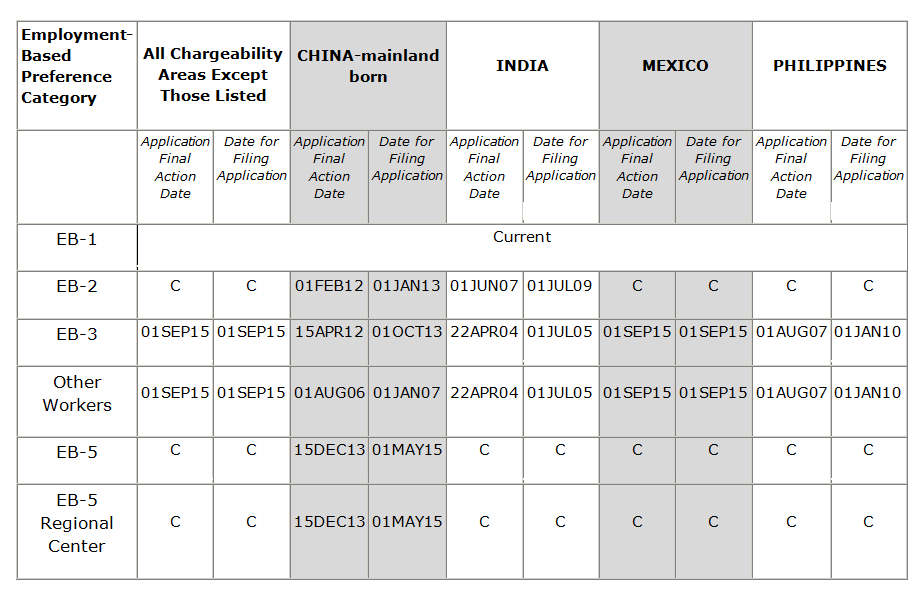
According to the State Department’s December Visa Bulletin, the cutoff date for final issuance of an immigrant visa will advance by ten months for EB-2 India, to June 1, 2007, but will remain unchanged at February 1, 2012 for EB-2 China. For EB-5 China, the final action cutoff date will advance by three weeks, to December 15, 2013. In all other backlogged employment-based preference categories, cutoff dates for final action will advance modestly.
There will be no advancement in employment-based cutoff dates for eligibility to file an application for permanent residence. USCIS has not yet confirmed whether it will continue to accept adjustment of status applications from foreign nationals whose priority date makes them eligible to file in December. The agency will make an announcement later this month on its own Visa Bulletin web page.
EMPLOYMENT-BASED PRIORITY DATE CUTOFFS FOR DECEMBER 2015
This alert is for informational purposes only. If you have any questions, please do not hesitate to contact the immigration professional with whom you work at Fragomen.

Country / Territory
Explore more at Fragomen
Media mentions
Partners Isha Atassi and Rahul Soni discuss US investment-based immigration options for Middle Eastern investors.
Blog post
Partner Ali Haider, Director Shoaib Khaleeli, Manager Ruaida Hussein and Senior Immigration Consultant Katerina Hornickova examine why degree equivalency has become mandatory in the United Arab Emirates and how the process affects employment, professional licensing and visa eligibility.
Video
Senior Associate Isabel Schnitzler explains key eligibility requirements for naturalization in Germany, including residence, language proficiency and financial self-sufficiency, as well as family eligibility considerations.
Media mentions
Partner Bo Cooper explains the impact of wage‑weighted selection on H‑1B registration and compliance.
Media mentions
Partner Aaron Blumberg explains how heightened government scrutiny affecting students from countries such as Venezuela is shaping travel guidance for those studying in the US.
Media mentions
Partner K. Edward Raleigh highlights how recent H-1B changes are shaping employer compliance strategies.
Media mentions
Practice Leader Colm Collins explains that processing delays, shifting demand in information and communication technology (ICT) and renewal cycles contributed to last year’s drop in work permit approvals.
Media mentions
Partner Rick Lamanna examines current pressures on Canada’s immigration system, including processing delays, reduced admissions and policy uncertainty and the implications for applicants and employers.
Blog post
Manager Mihaela Dumitru outlines how Swiss authorities assess Employer of Record and body-leasing models, highlighting key compliance risks, licensing requirements and a regulatory update affecting EU and EFTA nationals effective 1 January 2026.

Media mentions
Partner Karolina Schiffter discusses how courts in Poland are reinforcing timely processing and constitutional protections for foreigners.
Media mentions
Partners Isha Atassi and Rahul Soni discuss US investment-based immigration options for Middle Eastern investors.
Blog post
Partner Ali Haider, Director Shoaib Khaleeli, Manager Ruaida Hussein and Senior Immigration Consultant Katerina Hornickova examine why degree equivalency has become mandatory in the United Arab Emirates and how the process affects employment, professional licensing and visa eligibility.
Video
Senior Associate Isabel Schnitzler explains key eligibility requirements for naturalization in Germany, including residence, language proficiency and financial self-sufficiency, as well as family eligibility considerations.
Media mentions
Partner Bo Cooper explains the impact of wage‑weighted selection on H‑1B registration and compliance.
Media mentions
Partner Aaron Blumberg explains how heightened government scrutiny affecting students from countries such as Venezuela is shaping travel guidance for those studying in the US.
Media mentions
Partner K. Edward Raleigh highlights how recent H-1B changes are shaping employer compliance strategies.
Media mentions
Practice Leader Colm Collins explains that processing delays, shifting demand in information and communication technology (ICT) and renewal cycles contributed to last year’s drop in work permit approvals.
Media mentions
Partner Rick Lamanna examines current pressures on Canada’s immigration system, including processing delays, reduced admissions and policy uncertainty and the implications for applicants and employers.
Blog post
Manager Mihaela Dumitru outlines how Swiss authorities assess Employer of Record and body-leasing models, highlighting key compliance risks, licensing requirements and a regulatory update affecting EU and EFTA nationals effective 1 January 2026.

Media mentions
Partner Karolina Schiffter discusses how courts in Poland are reinforcing timely processing and constitutional protections for foreigners.


