Serie für den Mittelstand: EU Meldepflichten - was beinhaltet die EU Dokumentenaufbewahrung?
November 21, 2019

Country / Territory

Related contacts
Related offices
Related contacts
Related offices
Related contacts
Related offices
By: Audrey Morew
Willkommen bei unserer neuen Serie für den Mittelstand zum Thema Mitarbeiterentsendung und Compliance! In unserem siebten Artikel greifen wir die wichtigsten Punkte zur Daten- und Dokumentenaufbewahrung im Kontext der EU Meldepflichten auf.
Teilen Sie uns gerne Ihre Herausforderungen zu den EU Meldepflichten mit und wir werden diese in zukünftigen Beiträgen adressieren.
Die europäische Gesetzgebung (die so genannten Entsenderichtlinien) erlaubt EU Mitgliedstaaten verwaltungstechnische Kontrollmaßnahmen im Rahmen der Mitarbeiterentsendung einzurichten, um eine effektive Überwachung zur Einhaltung der Meldeverpflichtungen sicherzustellen.
Hinzu kommt, dass die Anforderungen an die Dokumentenspeicherung komplexer werden, da hohe Strafen mit der Nichterfüllung der Anforderungen verbunden sind.
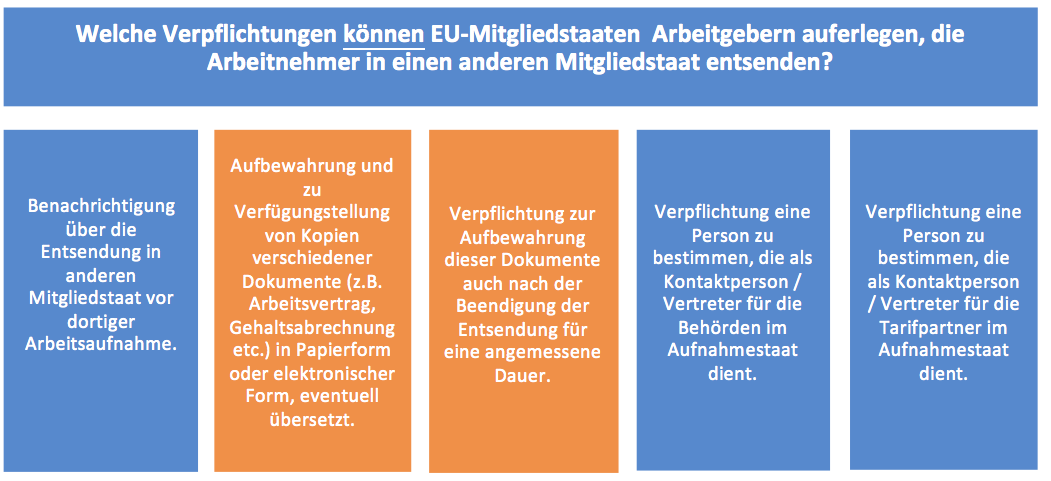
In den meisten Mitgliedsstaaten müssen Arbeitgeber folgende Dokumente aufbewahren:
- Arbeitsvertrag
- Gehaltsnachweis
- Nachweis über Arbeitszeiten
- Zertifikat bezüglich der Gesetzgebung zur anwendbaren Sozialversicherung (z.B. A1-Bescheinigung)
- Kopie der Meldung
Wie sollten die Dokumente aufbewahrt werden?
Die EU-Mitgliedstaaten verfolgen unterschiedliche Ansätze: in den meisten Ländern werden die Dokumente digital akzeptiert, in manchen Ländern jedoch nur in Papierform.
Die Fristen sind unterschiedlich, zum Beispiel:
- Österreich: bis zur Rückkehr des entsandten Mitarbeiters
- Frankreich: bis zu 5 Jahren nach Rückkehr des entsandten Mitarbeiters
- Belgien: bis zu 1 Jahr nach Rückkehr des entsandten Mitarbeiters
- Luxemburg: bis zur Rückkehr des entsandten Mitarbeiters
- Nicht durch das Gesetz festgelegt: Malta, Slowakei, Litauen
Grundsätzlich können Übersetzungen der Dokumente notwendig sein, wenn diese nicht in lokaler Sprache vorliegen. Dies variiert von Mitgliedstaat zu Mitgliedstaat und kann im Ermessen der Behörden angefragt werden.
Überarbeitung der EU-Entsenderichtlinie
Wir brauchen faire Bedingungen
EU Measures to Combat Social Dumping: An Overview in Context of Posted Workers

Country / Territory
Related contacts
Related offices
Related contacts
Related offices
Related contacts
Related offices
Explore more at Fragomen
Media mentions
Partners Isha Atassi and Rahul Soni discuss US investment-based immigration options for Middle Eastern investors.
Blog post
Partner Ali Haider, Director Shoaib Khaleeli, Manager Ruaida Hussein and Senior Immigration Consultant Katerina Hornickova examine why degree equivalency has become mandatory in the United Arab Emirates and how the process affects employment, professional licensing and visa eligibility.
Video
Senior Associate Isabel Schnitzler explains key eligibility requirements for naturalization in Germany, including residence, language proficiency and financial self-sufficiency, as well as family eligibility considerations.
Media mentions
Partner Bo Cooper explains the impact of wage‑weighted selection on H‑1B registration and compliance.
Media mentions
Partner Aaron Blumberg explains how heightened government scrutiny affecting students from countries such as Venezuela is shaping travel guidance for those studying in the US.
Media mentions
Partner K. Edward Raleigh highlights how recent H-1B changes are shaping employer compliance strategies.
Media mentions
Practice Leader Colm Collins explains that processing delays, shifting demand in information and communication technology (ICT) and renewal cycles contributed to last year’s drop in work permit approvals.
Media mentions
Partner Rick Lamanna examines current pressures on Canada’s immigration system, including processing delays, reduced admissions and policy uncertainty and the implications for applicants and employers.
Blog post
Manager Mihaela Dumitru outlines how Swiss authorities assess Employer of Record and body-leasing models, highlighting key compliance risks, licensing requirements and a regulatory update affecting EU and EFTA nationals effective 1 January 2026.

Media mentions
Partner Karolina Schiffter discusses how courts in Poland are reinforcing timely processing and constitutional protections for foreigners.
Media mentions
Partners Isha Atassi and Rahul Soni discuss US investment-based immigration options for Middle Eastern investors.
Blog post
Partner Ali Haider, Director Shoaib Khaleeli, Manager Ruaida Hussein and Senior Immigration Consultant Katerina Hornickova examine why degree equivalency has become mandatory in the United Arab Emirates and how the process affects employment, professional licensing and visa eligibility.
Video
Senior Associate Isabel Schnitzler explains key eligibility requirements for naturalization in Germany, including residence, language proficiency and financial self-sufficiency, as well as family eligibility considerations.
Media mentions
Partner Bo Cooper explains the impact of wage‑weighted selection on H‑1B registration and compliance.
Media mentions
Partner Aaron Blumberg explains how heightened government scrutiny affecting students from countries such as Venezuela is shaping travel guidance for those studying in the US.
Media mentions
Partner K. Edward Raleigh highlights how recent H-1B changes are shaping employer compliance strategies.
Media mentions
Practice Leader Colm Collins explains that processing delays, shifting demand in information and communication technology (ICT) and renewal cycles contributed to last year’s drop in work permit approvals.
Media mentions
Partner Rick Lamanna examines current pressures on Canada’s immigration system, including processing delays, reduced admissions and policy uncertainty and the implications for applicants and employers.
Blog post
Manager Mihaela Dumitru outlines how Swiss authorities assess Employer of Record and body-leasing models, highlighting key compliance risks, licensing requirements and a regulatory update affecting EU and EFTA nationals effective 1 January 2026.

Media mentions
Partner Karolina Schiffter discusses how courts in Poland are reinforcing timely processing and constitutional protections for foreigners.

![Porthole headshot iamge of Fragomen [Frankfurt][Manager][AudreyMorew]](https://www.fragomen.com/a/web/mVTApShNJZSwzoP7SWreUa/39SdjN/morew_audrey_porthole.jpg)

