Important Updates
Important Updates
May 8, 2026 | SwedenSweden: More Flexible Migration Rules for Researchers and Doctoral Candidates, Alongside Stricter Controls in Study Permit System
May 8, 2026 | European UnionEuropean Union/Schengen Area: Internal Schengen Border Checks Situation
May 8, 2026 | MexicoMexico: Processing Delays Impacting Immigration Timelines
May 8, 2026 | MexicoMexico: Reminder: Use of Automated Immigration Kiosks at Airports
May 8, 2026 | 🌐Minimum Salary Changes Announced
May 8, 2026 | SwedenSweden: More Flexible Migration Rules for Researchers and Doctoral Candidates, Alongside Stricter Controls in Study Permit System
May 8, 2026 | European UnionEuropean Union/Schengen Area: Internal Schengen Border Checks Situation
May 8, 2026 | MexicoMexico: Processing Delays Impacting Immigration Timelines
May 8, 2026 | MexicoMexico: Reminder: Use of Automated Immigration Kiosks at Airports
May 8, 2026 | 🌐Minimum Salary Changes Announced
May 8, 2026 | SwedenSweden: More Flexible Migration Rules for Researchers and Doctoral Candidates, Alongside Stricter Controls in Study Permit System
Subscribe
Fragomen.com home
Select Language
  • English
  • French
  • French - Canadian
  • German

Select Language

  • English
  • French
  • French - Canadian
  • German
ContactCareersMediaClient Portal
Search Fragomen.com
  • Our Services
    For EmployersFor IndividualsBy IndustryCase Studies
  • Our Tech & Innovation
  • Our People
  • Our Insights
    Worldwide Immigration Trends ReportsMagellan SeriesImmigration AlertsEventsMedia MentionsFragomen NewsBlogsPodcasts & Videos
  • Spotlights
    Travel and Mobility Considerations: Situation in the Middle EastNavigating Immigration Under the Second Trump AdministrationImmigration Matters: Your U.S. Compliance RoadmapCenter for Strategy and Applied InsightsVietnamese ImmigrationView More
  • About Us
    About FragomenOfficesResponsible Business PracticesFirm GovernanceRecognition

Our Services

  • For Employers
  • For Individuals
  • By Industry
  • Case Studies

Our Tech & Innovation

  • Our Approach

Our People

  • Overview / Directory

Our Insights

  • Worldwide Immigration Trends Reports
  • Magellan Series
  • Immigration Alerts
  • Events
  • Media Mentions
  • Fragomen News
  • Blogs
  • Podcasts & Videos

Spotlights

  • Travel and Mobility Considerations: Situation in the Middle East
  • Navigating Immigration Under the Second Trump Administration
  • Immigration Matters: Your U.S. Compliance Roadmap
  • Center for Strategy and Applied Insights
  • Vietnamese Immigration
  • View More

About Us

  • About Fragomen
  • Offices
  • Responsible Business Practices
  • Firm Governance
  • Recognition
Select Language
  • English
  • French
  • French - Canadian
  • German

Select Language

  • English
  • French
  • French - Canadian
  • German
ContactCareersMediaClient Portal
  • Insights

Federal Immigration Agencies Release Fall 2019 Regulatory Agendas

November 20, 2019

insight-news-default

Country / Territory

  • United StatesUnited States

Share

  • Twitter
  • Facebook
  • LinkedIn

Share

  • Twitter
  • Facebook
  • LinkedIn

Share

  • Twitter
  • Facebook
  • LinkedIn

Share

  • Twitter
  • Facebook
  • LinkedIn

Share

  • Twitter
  • Facebook
  • LinkedIn

Share

  • Twitter
  • Facebook
  • LinkedIn

At a Glance

  • In its regulatory plan for the coming months, the Department of Homeland Security announced new plans to toughen L-1 intracompany transferee eligibility criteria and impose wage obligations on the L-1 program.
  • A new regulatory agenda item would impose significant penalties on nonimmigrants who deviate from the terms of their status.
  • DHS continues to move forward with plans to heighten H-1B eligibility and wage standards, rescind the H-4 employment authorization program, further restrict the EB-5 program, restrict F-1 practical training programs, and eliminate the concurrent filing of adjustment of status applications with Form I-140 employment-based immigrant visa petitions.

The issue

The Departments of Homeland Security and State have announced their Fall 2019 regulatory agendas, which disclose each agency’s immigration rulemaking priorities for the coming months. When and if finalized, these rules could significantly impact the H-1B, L-1 and EB-5 programs, H-4 employment authorization, and adjustment of status filing procedures, among other programs and processes.

The following summarizes key employment-based items on the agencies’ immigration agendas. In all cases, the details of proposed and final regulations are confidential until released for publication.  Projected publication dates are subject to change.

H-1B and L-1 reforms; termination of H-4 employment authorization

A new entry to the DHS regulatory agenda, planned for publication in September 2020, is a proposal to redefine L-1B specialized knowledge, as well as L-1 employment and employer-employee relationships, with a likely focus on further restrictions on offsite placement of L-1 employees. The proposal is also expected to impose new wage obligations on L-1 employers, though the regulatory agenda does not specify the nature of these obligations. Unlike the H-1B program, the L-1 program is not currently subject to wage requirements.

DHS continues to move forward with a long-promised proposal to revise the definition of an H-1B specialty occupation to “increase focus on obtaining the best and brightest foreign nationals.” Originally slated to be published for public comment in August of this year, it is now projected for December 2019. The rule is expected to revise the definitions of “employment” and “employer-employee relationship,” with a likely focus on restriction of offsite placement of H-1B workers. The proposal is also anticipated to address H-1B wages.

A long-deferred proposal to rescind a program that permits certain H-4 spouses to apply for employment authorization is now projected to be published March 2020. The details of the proposed rule – including whether currently valid H-4 EADs will remain valid until their expiration – are not yet known. 

Foreign student periods of stay and practical training

A proposal by ICE to modify the period of authorized stay for certain F-1 and other nonimmigrants from duration of status (D/S) to a specified end date, retains the same publication date of February 2020.  Currently, foreign nationals with a D/S period of authorized stay are permitted to remain in the United States until the end of their authorized activity (plus any applicable grace period), whichever date that may be.

In addition, ICE’s proposal to revise practical training rules for F and M foreign students has returned to the regulatory agenda with an anticipated publication date of August 2020.  This practical training rule had been removed from the Fall 2018 regulatory agenda and temporarily placed on the agency’s long-term action list.  The forthcoming proposal is expected to seek restrictions on 12-month optional practical training (OPT), STEM OPT extensions, and curricular practical training (CPT).

Business visitors

DHS and the State Department intend to propose a rule to ensure a more rigorous implementation of the B-1/B-2 business or tourist visitor visa classification. This proposed regulation, which had initially been slated for publication in October 2019, is now scheduled for March 2020. It is expected to change current policy in some respects, possibly by restricting permissible business visitor activities. These restrictions could include the elimination of policies that allow B-1 visitors to engage in work in the United States in limited circumstances, such as the use of B-1 in lieu of the H-1B classification.  A proposed amendment to a related State Department regulation would similarly restrict the ability to work in B-1 status; this proposal is slated for December 2019.

Consequences of nonimmigrant status violations

A new proposal seeks to codify DHS’s policies concerning accrual of unlawful presence and the three- and ten-year bars to admissibility.  One element of this proposal could cause foreign nationals to accrue unlawful presence if they violate the terms of their nonimmigrant stay, such as engaging in additional employment or other activities that are not permitted under the rules of the program under which they were admitted.

EB-5 program

DHS continues to proceed with two proposals for further reform of the EB-5 program, just days before a final regulation to increase EB-5 investment minimums is set to take effect.

A proposal to change the way EB-5 Regional Centers are designated has an updated anticipated publication date of August 2020. The proposed rule was originally scheduled for publication in March 2019 and was subsequently deferred to March 2020.

An advance notice of proposed rulemaking is to seek public comment on monitoring and oversight of the EB-5 program as well as encouragement of investment in rural areas in advance of a broader proposal to alter the program. The advance notice has a revised publication date of September 2020. The notice was originally slated for September 2019 and was subsequently deferred to March 2020.

Green card processing

A proposal to change the way adjustment of status applications are processed is now slated for publication in April 2020, deferred from September 2019. The proposal seeks to discontinue the concurrent filing of adjustment of status applications with Form I-140 employment-based immigrant visa petitions and other preference petitions. This proposal could have a significant impact on employment-based green card applicants, including delaying the filing of applications for adjustment-based employment authorization and advance parole documents.

Fee increases 

The U.S. Department of State intends to increase consular filing fees, which includes nonimmigrant and immigrant visa application fees. Its proposed fee rule is scheduled for November 2019.  It was originally slated for July 2019.

What’s ahead: the regulatory timeline and impact on current immigration programs
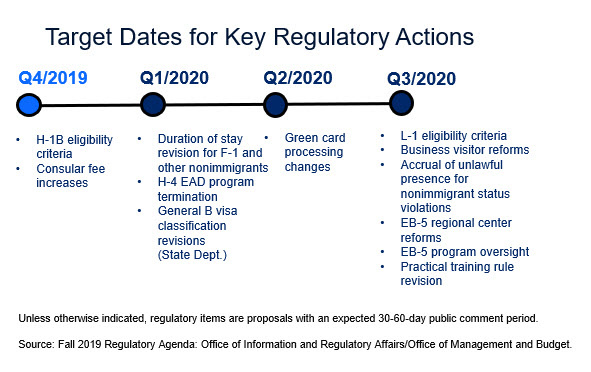
Agency regulatory agendas do not have an immediate effect on current programs, but are the clearest indication of the Trump Administration’s continued plans to restrict the H-1B, L-1, EB-5, and H-4 EAD programs. Organizations should take note of the forthcoming proposals when planning for future immigration needs, but should be aware that postponement of projected publication dates is common. 

In most cases, the agency is expected to publish proposed regulations through regular administrative procedures. This would include a comment period to allow individuals and organizations to provide feedback, though a comment period is not guaranteed in all cases. Proposed rules would not take effect until the agency completed the regulatory approval process, which normally takes several months or more.  

If your organization wishes to comment on a proposed regulation, please contact your designated Fragomen professional or the firm’s Government Strategies and Compliance Group.

This alert is for informational purposes only. If you have any questions, please contact the immigration professional with whom you work at Fragomen.


Country / Territory

  • United StatesUnited States

Share

  • Twitter
  • Facebook
  • LinkedIn

Share

  • Twitter
  • Facebook
  • LinkedIn

Share

  • Twitter
  • Facebook
  • LinkedIn

Share

  • Twitter
  • Facebook
  • LinkedIn

Share

  • Twitter
  • Facebook
  • LinkedIn

Share

  • Twitter
  • Facebook
  • LinkedIn

Explore more at Fragomen

Video

Portugal Extends Citizenship Timeline| #MobilityMinute

In this Mobility Minute, Manager Pierangelo D’Errico discusses Portugal’s newly approved nationality law changes and the potential impact on Golden Visa applicants and other foreign residents.

Learn more

Media mentions

Global Mobility Lawyer: AI Use in UK Immigration Tribunals Prompts Scrutiny Over Decision-Making Process

Partner Rajiv Naik highlights the importance of transparency, clear guidance and human oversight as AI use expands in UK immigration tribunals.

Learn more

Video

Europe’s Entry and Exit System (EES): What Travelers Need to Know

Senior Associate Tuğba Özyakup outlines how Europe’s Entry and Exit System (EES) introduces digital tracking of non-EU short-stay travel across the Schengen Area, requiring more proactive planning, accurate record-keeping and awareness of increased border processing times to avoid delays and overstay risks.

Learn more

Fragomen news

2026年4月 アメリカ移民法ダイジェストLearn more

Media mentions

Silicon Valley Business Journal: Trump’s H-1B Overhaul Favors Deep-Pocketed Bay Area Firms Over Indian Staffing Agencies

Partner Chad Ellsworth discusses recent H-1B lottery changes, including salary-weighted selection and filing restrictions, and how they are influencing employer selection outcomes and hiring approaches for foreign talent.

Learn more

Work authorization

EB-5 I-526E Request For Evidence Trends: Loans and Property Sales

Senior Associate Tracey Kimberly explores the recent increase in RFEs for EB‑5 I‑526E petitions, highlighting heightened USCIS scrutiny of source-of-funds documentation—particularly in cases involving loan-based investments and property sale proceeds.

Learn more

Work authorization

The Nordic Immigration Paradox: Why Digital Efficiency Still Creates Compliance Risk

Director Audrey Morew examines how Nordic immigration systems, while increasingly digital and efficient, can embed compliance risk earlier in the process—placing greater responsibility on employers to ensure data accuracy, internal controls and long‑term compliance from the outset.

Learn more

Work authorization

Canada FIFA World Cup 2026 Visa & Entry Requirements

Partner Rick Lamanna outlines Canada’s entry requirements for the FIFA World Cup 2026, highlighting visa and eTA processes, border expectations and special measures for participants to help travelers prepare for seamless entry during the tournament.

Learn more

Media mentions

The PIE: Relief for Some OPT Applicants in “Immigration Limbo”

Partners Aaron Blumberg and Daniel Pierce discuss how a US pause on processing certain work permit applications including OPT creates uncertainty for international students and employers while early court rulings offer limited case-specific relief.

Learn more

Fragomen news

European Migration Network (EMN) Belgium Report: Labour Migration in Times of Labour Shortages in Belgium

Senior Counsel Jo Antoons, Senior Immigration Managers Manuela Birsan and Andreia Ghimis, Senior Manager Wout Van Doren, Associate Pauline Chomel and Immigration Supervisor Elisabeth Kamm contributed to the European Migration Network (EMN) Belgium report "Labour Migration in Times of Labour Shortages in Belgium."

Learn more

Work authorization

From Investment to EU Residence: Why Italy’s Investor Visa is Gaining Momentum

Manager Pierangelo D'Errico explores how Italy’s Investor Visa is emerging as a strategic alternative to diminishing EU golden visa programmes, offering high‑net‑worth individuals flexible residence rights, deferred investment timing, Schengen access and a structured—though not accelerated—pathway to long‑term EU residence.

Learn more

Media mentions

The New York Times: Have a Canadian Great-Great Grandparent? It Could Make You Canadian.

Partner Rick Lamanna discusses Canada’s expanded citizenship by descent rules extending eligibility to potentially millions of people worldwide with only distant ancestral ties.

Learn more

Video

Portugal Extends Citizenship Timeline| #MobilityMinute

In this Mobility Minute, Manager Pierangelo D’Errico discusses Portugal’s newly approved nationality law changes and the potential impact on Golden Visa applicants and other foreign residents.

Learn more

Media mentions

Global Mobility Lawyer: AI Use in UK Immigration Tribunals Prompts Scrutiny Over Decision-Making Process

Partner Rajiv Naik highlights the importance of transparency, clear guidance and human oversight as AI use expands in UK immigration tribunals.

Learn more

Video

Europe’s Entry and Exit System (EES): What Travelers Need to Know

Senior Associate Tuğba Özyakup outlines how Europe’s Entry and Exit System (EES) introduces digital tracking of non-EU short-stay travel across the Schengen Area, requiring more proactive planning, accurate record-keeping and awareness of increased border processing times to avoid delays and overstay risks.

Learn more

Fragomen news

2026年4月 アメリカ移民法ダイジェストLearn more

Media mentions

Silicon Valley Business Journal: Trump’s H-1B Overhaul Favors Deep-Pocketed Bay Area Firms Over Indian Staffing Agencies

Partner Chad Ellsworth discusses recent H-1B lottery changes, including salary-weighted selection and filing restrictions, and how they are influencing employer selection outcomes and hiring approaches for foreign talent.

Learn more

Work authorization

EB-5 I-526E Request For Evidence Trends: Loans and Property Sales

Senior Associate Tracey Kimberly explores the recent increase in RFEs for EB‑5 I‑526E petitions, highlighting heightened USCIS scrutiny of source-of-funds documentation—particularly in cases involving loan-based investments and property sale proceeds.

Learn more

Work authorization

The Nordic Immigration Paradox: Why Digital Efficiency Still Creates Compliance Risk

Director Audrey Morew examines how Nordic immigration systems, while increasingly digital and efficient, can embed compliance risk earlier in the process—placing greater responsibility on employers to ensure data accuracy, internal controls and long‑term compliance from the outset.

Learn more

Work authorization

Canada FIFA World Cup 2026 Visa & Entry Requirements

Partner Rick Lamanna outlines Canada’s entry requirements for the FIFA World Cup 2026, highlighting visa and eTA processes, border expectations and special measures for participants to help travelers prepare for seamless entry during the tournament.

Learn more

Media mentions

The PIE: Relief for Some OPT Applicants in “Immigration Limbo”

Partners Aaron Blumberg and Daniel Pierce discuss how a US pause on processing certain work permit applications including OPT creates uncertainty for international students and employers while early court rulings offer limited case-specific relief.

Learn more

Fragomen news

European Migration Network (EMN) Belgium Report: Labour Migration in Times of Labour Shortages in Belgium

Senior Counsel Jo Antoons, Senior Immigration Managers Manuela Birsan and Andreia Ghimis, Senior Manager Wout Van Doren, Associate Pauline Chomel and Immigration Supervisor Elisabeth Kamm contributed to the European Migration Network (EMN) Belgium report "Labour Migration in Times of Labour Shortages in Belgium."

Learn more

Work authorization

From Investment to EU Residence: Why Italy’s Investor Visa is Gaining Momentum

Manager Pierangelo D'Errico explores how Italy’s Investor Visa is emerging as a strategic alternative to diminishing EU golden visa programmes, offering high‑net‑worth individuals flexible residence rights, deferred investment timing, Schengen access and a structured—though not accelerated—pathway to long‑term EU residence.

Learn more

Media mentions

The New York Times: Have a Canadian Great-Great Grandparent? It Could Make You Canadian.

Partner Rick Lamanna discusses Canada’s expanded citizenship by descent rules extending eligibility to potentially millions of people worldwide with only distant ancestral ties.

Learn more

Stay in touch

Subscribe to receive our latest immigration alerts

Subscribe

Our firm

  • About
  • Careers
  • Firm Governance
  • Media Inquiries
  • Recognition

Information

  • Attorney Advertising
  • Legal Notices
  • Privacy Policies
  • AI Transparency Statement
  • UK Regulatory Requirements

Our firm

  • About
  • Careers
  • Firm Governance
  • Media Inquiries
  • Recognition

Information

  • Attorney Advertising
  • Legal Notices
  • Privacy Policies
  • AI Transparency Statement
  • UK Regulatory Requirements

Have a question?

Contact Us
  • LinkedIn
  • Youtube
  • Instagram
  • Facebook
  • TikTok
  • Twitter

© 2026 Fragomen, Del Rey, Bernsen & Loewy, LLP, Fragomen Global LLP and affiliates. All Rights Reserved.

Please note that the content made available on this site is not intended for visitors / customers located in the province of Quebec, and the information provided is not applicable to the Quebec market. To access relevant information that applies to the Quebec market, please click here.