Navigating Australia’s Recent Immigration Changes: Assessing Compliance Risk and Monitoring Readiness
July 5, 2024

Country / Territory

Related contacts
Related offices
Related contacts
Related offices
Related contacts
Related offices
By: Anna Michalska
The onset of a new financial year typically heralds immigration adjustments, and 2024 is no exception.
New Legislation Targeting Employer Compliance
To combat migrant worker exploitation, the Australian Government implemented the Migration Amendment (Strengthening Employer Compliance) Act 2024 on July 1. Key provisions include:
-
-
- Introduction of criminal offenses for coercing individuals into work arrangements;
- Authority to prohibit employers from hiring more migrant workers for a period following certain immigration or employment related breaches; and
- Enhanced penalties and compliance measures, like compliance notices and enforceable undertakings for Right to Work violations.
-
In support of this legislation, the Department of Home Affairs (the Department) has bolstered its intelligence and compliance capabilities, alongside implementing stricter post-arrival monitoring to ensure employees are paid at least their nominated earnings.
Educational Campaign and Enhanced Monitoring
The Australian Border Force's (ABF) Sponsor Monitoring Units have conducted an educational campaign for sponsors nationwide, raising awareness of sponsorship obligations and informing them of their obligations under the Strengthening Employer Compliance legislation. Increased monitoring and enforcement activities are now expected.
Preparation and Protocol Implementation
Employers are advised to establish internal protocols for ABF site visits promptly and ensure relevant information can be provided to the ABF officers without delay. In case of monitoring, the Department typically requests, within 14 days:
-
-
- Organizational chart;
- List of all visa-holding employees;
- Details of any sponsored employees who have ceased employment;
- Updates on business circumstances since the last sponsorship approval;
- Disclosure of adverse information; and
- Documentation for selected visa holders, such as employment contracts, payslips, leave records, evidence of market rates, etc.
-
Assessing Compliance Risk and Monitoring Readiness
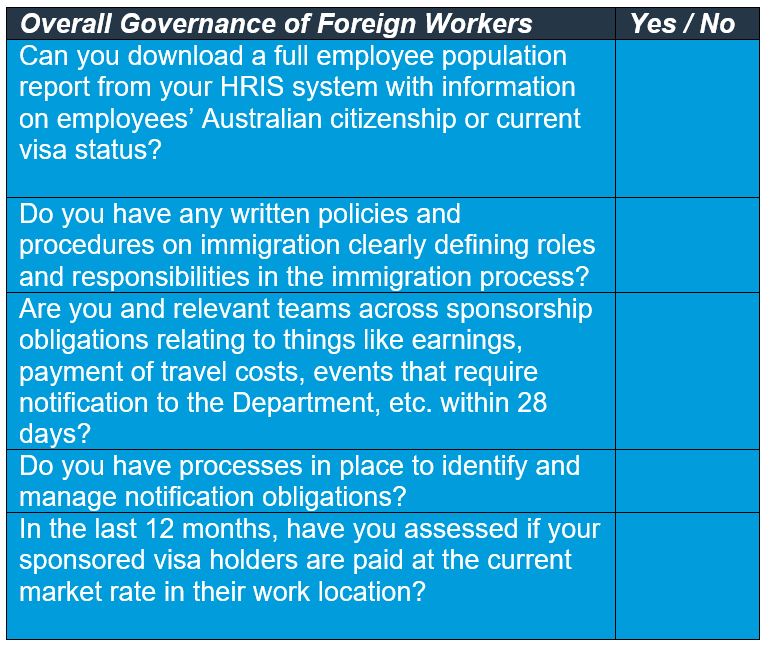
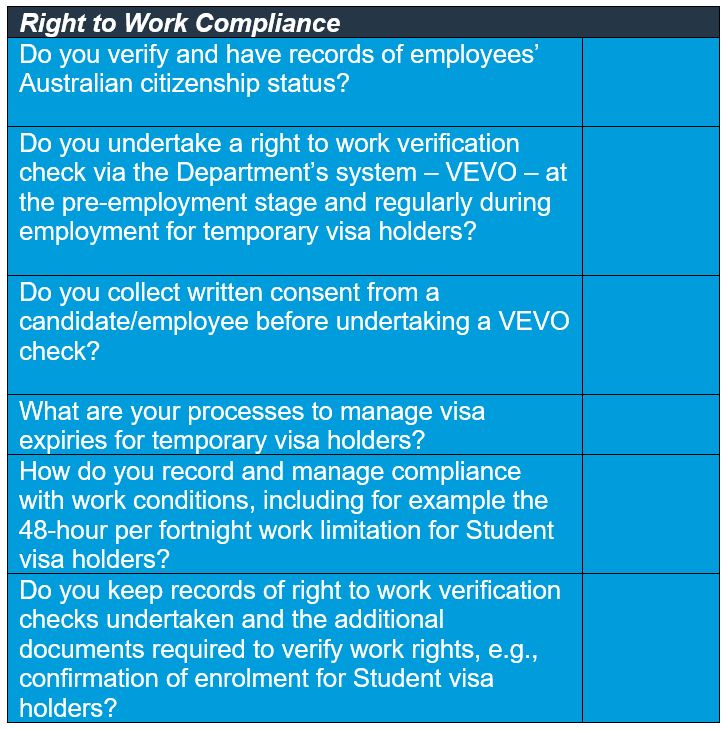
Evaluate your readiness for a potential ABF monitoring using our checklist below. The checklist can also help you to identify key risk areas and actions required to mitigate these risks to protect the business from consequences of non-compliance. 
Need to Know More?
Fragomen can assist with reviewing the current state of your immigration program and compliance and assess the business’ readiness to respond to a monitoring request. We can also help with developing immigration policies, conduct training for your HR teams and implement an automated VEVO check solution via our proprietary tool, WorkRight. Please contact [email protected] to learn more.
This blog was published on 5 July 2024, and due to the circumstances, there are frequent changes. To keep up to date with all the latest updates on global immigration, please visit our dedicated COVID-19 site, subscribe to our alerts and follow us on LinkedIn, Twitter, Facebook and Instagram.

Country / Territory
Related contacts
Related offices
Related contacts
Related offices
Related contacts
Related offices
Explore more at Fragomen
Media mentions
Partner Bo Cooper explains the impact of wage‑weighted selection on H‑1B registration and compliance.
Media mentions
Partner K. Edward Raleigh highlights how recent H-1B changes are shaping employer compliance strategies.
Media mentions
Practice Leader Colm Collins explains that processing delays, shifting demand in information and communication technology (ICT) and renewal cycles contributed to last year’s drop in work permit approvals.
Media mentions
Partner Rick Lamanna examines current pressures on Canada’s immigration system, including processing delays, reduced admissions and policy uncertainty and the implications for applicants and employers.
Blog post
Manager Mihaela Dumitru outlines how Swiss authorities assess Employer of Record and body-leasing models, highlighting key compliance risks, licensing requirements and a regulatory update affecting EU and EFTA nationals effective 1 January 2026.

Media mentions
Partner Karolina Schiffter discusses how courts in Poland are reinforcing timely processing and constitutional protections for foreigners.
Blog post
Immigration Manager Alice Heron examines Ireland’s updated employment permit salary thresholds taking effect in March 2026, including the reintroduction of graduate-specific Minimum Annual Remuneration bands and what these changes mean for employers planning graduate recruitment in 2026 and 2027.
Media mentions
Partner Jill Bloom explains how the new wage-based H-1B selection rule may influence hiring decisions and prompt employers to reassess workforce planning and explore alternative visa options.
Media mentions
Partner K. Edward Raleigh discusses how companies are rethinking their H-1B strategies amid evolving policies.
Media mentions
Partner Bo Cooper explains the impact of wage‑weighted selection on H‑1B registration and compliance.
Media mentions
Partner K. Edward Raleigh highlights how recent H-1B changes are shaping employer compliance strategies.
Media mentions
Practice Leader Colm Collins explains that processing delays, shifting demand in information and communication technology (ICT) and renewal cycles contributed to last year’s drop in work permit approvals.
Media mentions
Partner Rick Lamanna examines current pressures on Canada’s immigration system, including processing delays, reduced admissions and policy uncertainty and the implications for applicants and employers.
Blog post
Manager Mihaela Dumitru outlines how Swiss authorities assess Employer of Record and body-leasing models, highlighting key compliance risks, licensing requirements and a regulatory update affecting EU and EFTA nationals effective 1 January 2026.

Media mentions
Partner Karolina Schiffter discusses how courts in Poland are reinforcing timely processing and constitutional protections for foreigners.
Blog post
Immigration Manager Alice Heron examines Ireland’s updated employment permit salary thresholds taking effect in March 2026, including the reintroduction of graduate-specific Minimum Annual Remuneration bands and what these changes mean for employers planning graduate recruitment in 2026 and 2027.
Media mentions
Partner Jill Bloom explains how the new wage-based H-1B selection rule may influence hiring decisions and prompt employers to reassess workforce planning and explore alternative visa options.
Media mentions
Partner K. Edward Raleigh discusses how companies are rethinking their H-1B strategies amid evolving policies.