Teil 4 der Serie: A1-Antrag Mehrfachbeschäftigung - was Sie wissen sollten.
October 31, 2019


Country / Territory
Related offices
Related offices
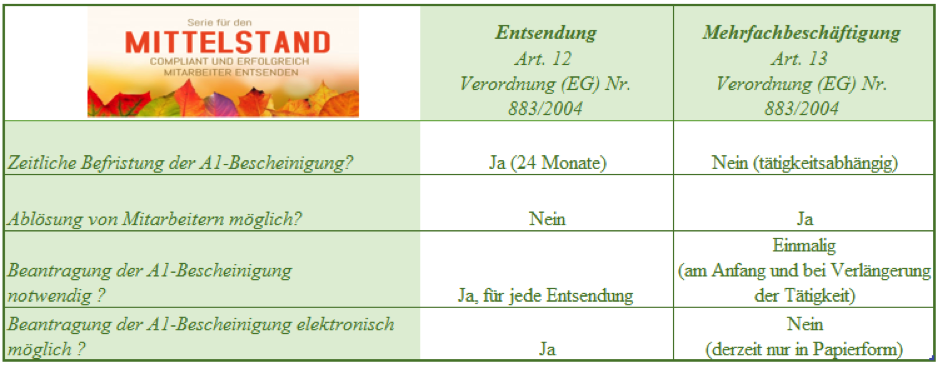
Willkommen bei unserer neuen Serie für den Mittelstand zum Thema Mitarbeiterentsendung und Compliance! In unserem vierten Artikel greifen wir die wichtigsten Punkte zur Mehrfachbeschäftigung aus sozialversicherungsrechtlicher Sicht auf.
Teilen Sie uns gerne Ihre Herausforderungen zur A1-Bescheinigung mit und wir werden diese in zukünftigen Beiträgen adressieren.
Die A1-Bescheinigung gilt als ein Entsendeausweis, der bestätigt welches Sozialsystem für einen entsandten Mitarbeiter zuständig ist. Grundsätzlich unterliegt eine Person den Sozialversicherungsvorschriften jenes Staates, in dem die Tätigkeit, selbständig oder nicht-selbständig, ausgeübt wird (Territorialitätsprinzip). Durch die A1-Bescheinigung wird vermieden, dass bei einer Entsendung Sozialversicherungsbeiträge gleichzeitig in zwei EU-Staaten fällig werden.
Wann üben Arbeitnehmer eine Erwerbstätigkeit in mehreren Mitgliedstaaten aus?
Arbeitnehmer üben eine Erwerbstätigkeit gewöhnlich in mehreren Mitgliedstaaten aus, wenn - bezogen auf die kommenden 12 Monate - davon auszugehen ist, dass sie zum Beispiel für ihren Arbeitgeber regelmäßig (mindestens an einem Tag im Monat oder an mindestens fünf Tagen im Quartal) in Deutschland und auch in einem bestimmten anderen Mitgliedstaat arbeiten.
Auch wenn Arbeitnehmer beispielsweise bei zwei Arbeitgebern beschäftigt sind (z.B. Vorstandsmitglied in Tochterunternehmen im Ausland), und für diese Unternehmen in unterschiedlichen Mitgliedstaaten arbeiten, üben Arbeitnehmer laut Gesetz ihre Erwerbstätigkeit gewöhnlich in mehreren Mitgliedstaaten aus.
Dies gilt selbst dann, wenn es sich bei einer dieser Beschäftigungen um eine geringfügige Beschäftigung handelt.
Wo muss man eine A1-Bescheinigung beantragen, wenn Arbeitnehmer eine Erwerbstätigkeit in mehreren Mitgliedstaaten ausüben?
Wenn Arbeitnehmer ihre Erwerbstätigkeit gewöhnlich in mehreren Mitgliedstaaten ausüben, sollten sie sich an die zuständige Stelle ihres Wohnstaates wenden. Sie stellt fest, welcher Mitgliedstaat für ihren sozialen Schutz zuständig ist.
Sofern Arbeitnehmer ihre Erwerbstätigkeit gewöhnlich in mehreren Mitgliedstaaten ausüben und in Deutschland wohnen, ist der GKV-Spitzenverband, DVKA für die Feststellung des anwendbaren Rechts zuständig. Soweit die deutschen Rechtsvorschriften gelten, erhalten Arbeitnehmer von hier auch die A1-Bescheinigung.
Für die verschiedenen Fallgestaltungen einer gewöhnlichen Erwerbstätigkeit in mehreren Mitgliedstaaten stehen unterschiedliche Anträge/Fragebögen zur Verfügung. Diese finden Sie hier.
EU Measures to Combat Social Dumping: An Overview in Context of Posted Workers

Country / Territory
Related offices
Related offices
Explore more at Fragomen
Awards
Fragomen is recognized with multiple honors at the 2026 FEM Americas EMMAs, including Outstanding Agility & Crisis Management as a Service Provider and Thought Leadership – Best Survey or Research Study of the Year for the Worldwide Immigration Trends Report 2026.
Blog post
Destination Services Director Christine Sperr examines how housing market reforms, rent stabilization measures and cost-of-living dynamics in Saudi Arabia are influencing workforce mobility, compensation planning and long-term settlement strategies under Vision 2030.
Visas
Manager Dr. Adela Schmidt explains how German authorities assess past travel and business activities and why suspected unauthorized work during prior visits can lead to visa refusals and temporary entry bans.
Podcast
Partner Cosmina Morariu and Senior Director Leah Rogal discuss the mission of Fragomen’s Center for Strategy and Applied Insights and how it helps organizations and governments navigate evolving immigration policy and global talent mobility challenges.
Fragomen news
Fragomen and Papaya Global announce a strategic partnership combining workforce technology and immigration capabilities to help organizations simplify global mobility, enhance compliance and manage cross-border workforces through a more integrated, technology-enabled approach.
Video
Latin America & the Caribbean Managing Partner Leonor Echeverria explores how Latin America’s evolving immigration landscape offers accessible and flexible residence pathways for foreign nationals, highlighting key visa options, regional trends and the growing role of digital modernization across the region.
Podcast
Senior Associate Stephanie Weaver and Associate Julia Manacher continue their discussion on immigration law in popular culture, examining how television and media portray immigration processes and the realities behind common immigration storylines.
Media mentions
Partner Kevin Miner discusses how proposed H-1B salary threshold increases may raise employer costs and influence hiring strategies for specialized talent across industries.
Video
In this Mobility Minute, Manager Pierangelo D’Errico discusses Portugal’s newly approved nationality law changes and the potential impact on Golden Visa applicants and other foreign residents.
Media mentions
Partner Rajiv Naik highlights the importance of transparency, clear guidance and human oversight as AI use expands in UK immigration tribunals.
Video
Senior Associate Tuğba Özyakup outlines how Europe’s Entry and Exit System (EES) introduces digital tracking of non-EU short-stay travel across the Schengen Area, requiring more proactive planning, accurate record-keeping and awareness of increased border processing times to avoid delays and overstay risks.
Awards
Fragomen is recognized with multiple honors at the 2026 FEM Americas EMMAs, including Outstanding Agility & Crisis Management as a Service Provider and Thought Leadership – Best Survey or Research Study of the Year for the Worldwide Immigration Trends Report 2026.
Blog post
Destination Services Director Christine Sperr examines how housing market reforms, rent stabilization measures and cost-of-living dynamics in Saudi Arabia are influencing workforce mobility, compensation planning and long-term settlement strategies under Vision 2030.
Visas
Manager Dr. Adela Schmidt explains how German authorities assess past travel and business activities and why suspected unauthorized work during prior visits can lead to visa refusals and temporary entry bans.
Podcast
Partner Cosmina Morariu and Senior Director Leah Rogal discuss the mission of Fragomen’s Center for Strategy and Applied Insights and how it helps organizations and governments navigate evolving immigration policy and global talent mobility challenges.
Fragomen news
Fragomen and Papaya Global announce a strategic partnership combining workforce technology and immigration capabilities to help organizations simplify global mobility, enhance compliance and manage cross-border workforces through a more integrated, technology-enabled approach.
Video
Latin America & the Caribbean Managing Partner Leonor Echeverria explores how Latin America’s evolving immigration landscape offers accessible and flexible residence pathways for foreign nationals, highlighting key visa options, regional trends and the growing role of digital modernization across the region.
Podcast
Senior Associate Stephanie Weaver and Associate Julia Manacher continue their discussion on immigration law in popular culture, examining how television and media portray immigration processes and the realities behind common immigration storylines.
Media mentions
Partner Kevin Miner discusses how proposed H-1B salary threshold increases may raise employer costs and influence hiring strategies for specialized talent across industries.
Video
In this Mobility Minute, Manager Pierangelo D’Errico discusses Portugal’s newly approved nationality law changes and the potential impact on Golden Visa applicants and other foreign residents.
Media mentions
Partner Rajiv Naik highlights the importance of transparency, clear guidance and human oversight as AI use expands in UK immigration tribunals.
Video
Senior Associate Tuğba Özyakup outlines how Europe’s Entry and Exit System (EES) introduces digital tracking of non-EU short-stay travel across the Schengen Area, requiring more proactive planning, accurate record-keeping and awareness of increased border processing times to avoid delays and overstay risks.

